• Category Archives Writing
  • Any and all posts pertaining to writing books, comics, articles, essays, blog posts, social media posts, and more.

  • What is Coming Up in 2017

    A.P. Fuchs 2017

    I commit to nothing.

    Bwahahaha.

    Post over.

    Kidding.

    However, I meant the above: I commit to nothing.

    Instead of doing the usual writer shtick of announcing what projects are coming out and when, I’m simply going to announce them as I complete them.

    There are only three confirmed titles coming from me in 2017 thus far. They have already been announced on this blog, but I will mention them again and mention why I know they are guaranteed to be released.

    The Canister X Transmission: Year Three – This is being written week-to-week and, like Years One and Two, the collections have been published within a couple of months of that newsletter’s year having ended.

    Untitled Flash Fiction Collection – This is part of the Year Three experience, so each week a new piece of flash fiction is sent out to readers. A total of 60 pieces of flash fiction will comprise this collection–52 from the weekly newsletter, a 53rd from the collected edition of the newsletter–and the remainder to be written afterward.

    Axiom-man and Auroraman: Frozen Storm – This is a novel I will be writing for a kickstarter project that begins in March. Since it’s being kickstarted, and assuming Auroraman creator Jeff Burton and I hit our goal, this book will be published on time for backers.

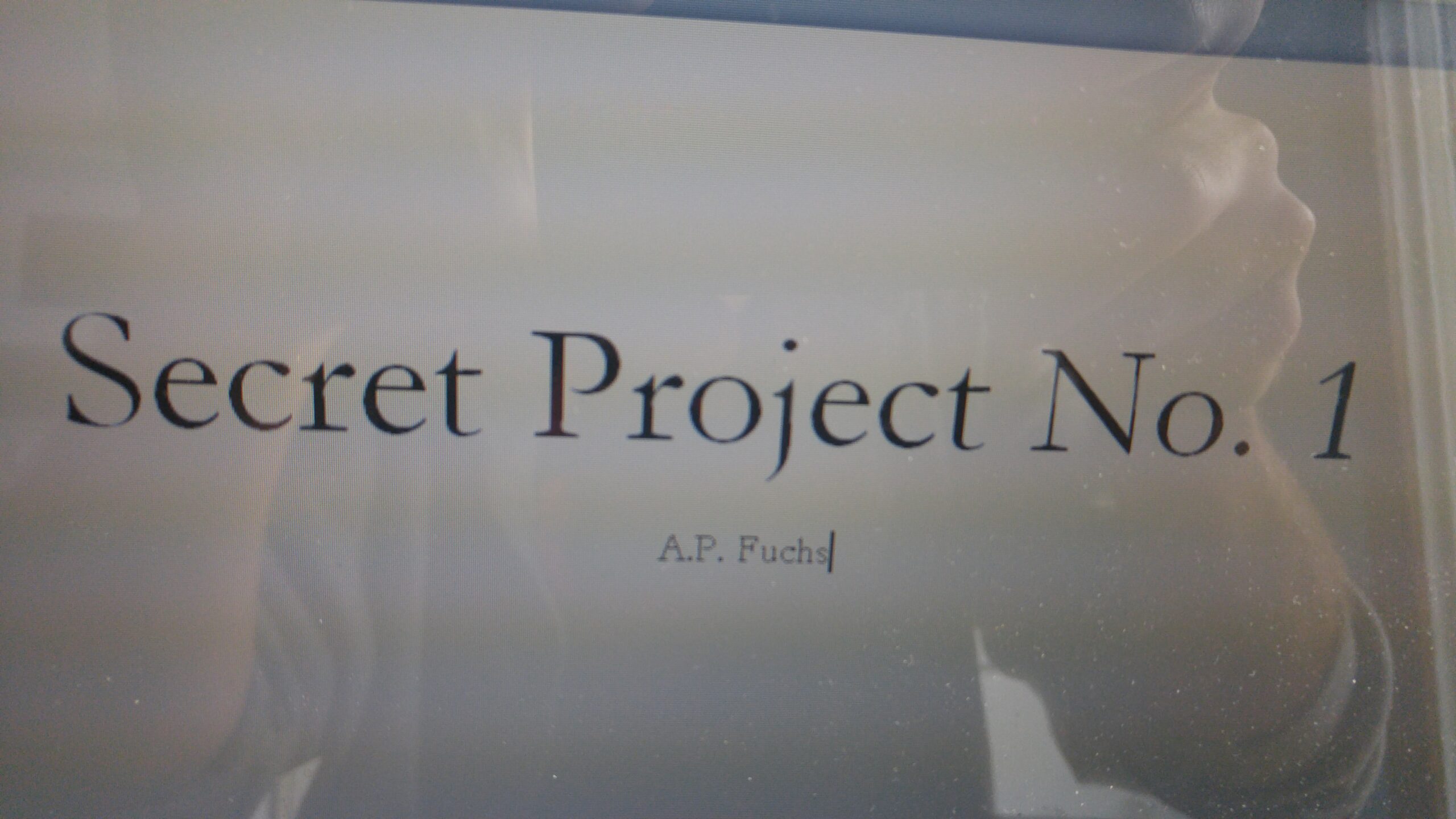
    Regarding Secret Project No. 1 and Secret Project No. 3–projects mentioned in my newsletter–they will be announced upon completion. What about Secret Project No. 2, you ask? Since it ties directly into Secret Project No. 1, I can’t say anything about it just yet.

    As for other works in various stages of finishing, same deal: they will be announced upon completion.

    Commit to nothing.

    I have also restructured my 2017 on-line marketing efforts and just today finished automating the whole year. There will be some manual posts but the rest will be the social media bots doing my bidding.

    Your best bet in keeping up-to-date on things is by regularly checking this blog or subscribing to my newsletter.

    Have a safe and Happy New Year.

    See you in 2017.


  • Late-night Transmission

    This note is being transmitted at 2:09 am. Having a bit of trouble sleeping so thought it best to write this via the smartphone and then do a short bit of smartphone writng afterward to help me fall asleep.

    I wanted to let you know of two guaranteed releases from me in 2017. I know these are guaranteed because they are being written simultaneously week to week right now. They’ll be ready to publish around June or July.

    They are:

    The Canister X Transmission: Year Three

    and

    An untitled collection of multi-genre flash fiction that will contain 60 short-short stories for your reading pleasure. Title to be announced once I think of one.

    I bid you all a goodnight.


  • The Meaning Behind Canister X

    The Meaning Behind Canister X

    Canister X

    “Canister X” is an unusual name for a blog. There’s a story behind why that name was chosen. It’s not a terribly exciting story, but perhaps one that’s slightly amusing.

    As is required of authors, a website is needed. Most writers use their name as their domain name. I did that, too, once upon a time. But one year–I can’t remember which–I forgot to renew the apfuchs.com domain and then I lost it. I tried to re-register it only to find out someone had snatched it up. The site was in German. I had no idea who this person was and didn’t know how to go about reaching them to see if I could have my domain back, so I had to come up with something else. If memory serves me correctly, I decided to rename the site with something unique. I can’t remember the options I went through but “Canister X” came to mind and I assigned meaning to that name. The “Canister” part is after Ninja Turtles, you know, the container that had the mutagen in it. The “X” part was about the site being about anything and not locking me into a particular idea or theme, and as you can see from the content on this site, it’s fairly varied. Sort of a “you never know what you’re gonna get.”

    Later, “Canister X” also became part of the title of my minicomics: Canister X Comix.

    I hope to one day get my A.P. Fuchs domain back and then use it to point to here or vice versa, but until then, Canister X is the name of this thing so we’re running with it.

    This is your blog history lesson for the day.


  • Winter Hiding and NaNoWriMo

    NaNoWriMo 2016

    Today, my winter hibernation period begins. (See last entry.)

    To kick it off, I’m starting a new project. A secret project. One of two secret projects.

    These secret projects will be part of NaNoWriMo, which needs to get done because I dropped the ball on NaNoWriMo last year for reasons I don’t remember. (For the uninitiated, NaNoWriMo stands for National Novel Writing Month in which writers are supposed to write a book in one month with a minimum of 50,000 words.)

    Since I’m notorious for being anti-establishment in so many ways, I’m not putting 50k words into a single project but over the course of two. Those two secret ones I mentioned.

    I’d better get to work.


  • Reinventing the Horde: Problems in Zombie Fiction

    Reinventing the Horde: Problems in Zombie Fiction

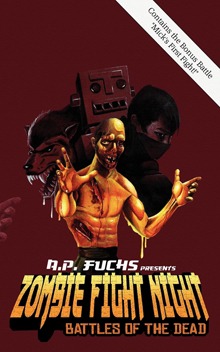
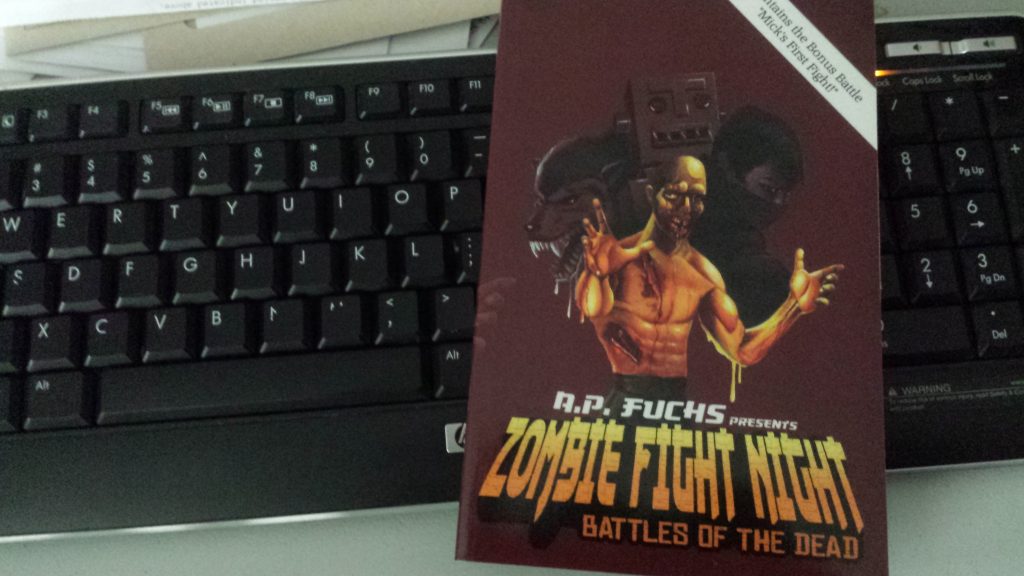
    Zombie Fight Night: Battles of the Dead Front Cover

    Author’s note: This essay originally aired on this blog prior to the file purge of 2014. It is now being rerun for your reading pleasure. Please note Zomtropolis is no longer available as a free on-line serial and will be released in paperback and eBook in the near future.

    Zombies are monsters. At least, that’s the standard definition. Someone dies, rises, has a taste of human flesh and so hunts down the living and, once the prey is caught, chows down and eats their guts. Oh, and they’re ugly, too, slowly rotting away with each passing day.

    That’s the standard version of the zombie and the one most are familiar with.

    It’s the one I knew of when I first discovered them, but as for their main backstory, I didn’t know what that wasy.

    See, I grew up in a household where horror and monsters where off limits. This was a good thing, in that I didn’t have to view creepy faces, see blood and guts, watch people get killed, or be subject to dark forests like other kids I knew. I was probably saved hundreds of hours of nightmares as a result. This absence of horror made for a happier childhood, in that regard. My dad always said, “If you want to watch horror, watch the news.” And he was right, and still is. We live in a sad world with villains in it that outmatch most of what we create in books or on screen.

    At the same time, being so sheltered was a detriment to a well-rounded upbringing because later on, I was naïve about a lot of things, including the darker side of life, both in terms of what humans were capable of and scary images.

    My first exposure to monsters was seeing a ripped-from-a-magazine picture of Freddy Krueger lying in the playground in elementary. The image of a disfigured man with bubbles on his skin was so foreign to me that I had occasional nightmares from that single image for years. I never saw an actual Freddy movie until I was eighteen and living on my own, but I got to tell you: going to the video store to rent one sent up all sorts of red flags and I was scared to watch A Nightmare on Elm Street for the first time.

    But zombies, werewolves or vampires growing up?

    At most I saw the Halloween episode of Highway to Heaven where Michael Landon was a werewolf for part of it. Scared me to death. Same with that other episode with the devil.

    Highway to Heaven. Good show, from what I remember, and it was allowed in the Christian household I grew up in for its message. It was also this growing up in a Christian household and the zero tolerance policy for horror and monsters that shaped my life, not only in terms of what I couldn’t see, but how I reacted when faced with the horrors that pop up in life now and then.

    In fact, I only got into horror because of something painful that happened to me. It was in this place of darkness that I found comfort in other dark things for a long time.

    Later, when I incorporated writing about zombies into my writing career, my view of the undead and fandom of them wasn’t your typical horror fan’s. It wasn’t the blood and guts that excited me or their spooky nature, the whole things-that-go-bump-in-the-night thing.

    Instead, it was rooted in my first love: superheroes.

    And they still are.

    I’ve never viewed zombies as “horror monsters” in terms of how I create and write them. To me, they’ve always been supervillains, and I think it’s this definition of them that is more accurate: they are “super” because they can’t die via conventional means—only by the removal of the head—and are certainly not part of our everyday lives, and they are “villains” because of the evil act of eating others they commit.

    When I set out to write my first zombie book, Blood of the Dead (book one of the Undead World Trilogy) I didn’t want to write a standard zombie novel about a virus, people dying, people coming back, people surviving. I’ve never been one for formulas in my fiction and have always tried to do something new with each tale. Once the story was done, it immediately birthed unusual plans for the sequel, Possession of the Dead: angels, demons, giant zombies some fifteen stories high, shamblers and sprinters, shape shifting zombies and the consequences of the time travel ending of the first book. The third, Redemption of the Dead, incorporated all these unusual elements, while neatly dealing with the time travel issue and ensuring it was paradox-free, which, as a major time travel fan, was something important to me. But all along, as these books were written, the zombies were supervillains to me, with my main cast—Joe, Billy, August, Des, Tracy—being superheroes in their own right, especially Joe and Tracy. While Joe was an excellent shot with the gun, tough as nails and grim, Tracy was a highly-skilled marksmen and fighter. Likewise, they had the tendency to rescue people versus just letting people die.

    The story certainly would not have been what it was without my love of the superhero genre and my sheltered upbringing. Doing zombie stories this way also enabled me to tackle Zombie Fight Night: Battles of the Dead, with a kind of comic book sensibility, that is, classic characters—ninjas, samurai, robots, Vikings, and more—and pit them up against the undead in Bloodsport-like battles, each fight with a purpose that served the overall story being told between each bout.

    The supervillain angle—I like it. I grew up with it, being a huge fan of Super Friends, the Christopher Reeve Superman flicks, the Tim Burton Batman movies, even the Spider-Man TV show. To be honest, I can’t imagine writing monsters any other way other than as supervillains because that’s what they are to me.

    Any monster is, actually, and I explored this idea in the series of anthologies I edit called Metahumans vs. The first two are Metahumans vs the Undead and Metahumans vs Werewolves. For the uninitiated, metahumans are superheroes are the same thing. The idea with this series was not only to showcase independent superheroes, but also put them up against a new kind of supervillain that isn’t used that often in comics or cartoons: monsters.

    Before you accuse me of this article being a giant commercial for my undead work—for free serial zombie fiction, see my on-line novel, Zomtropolis at www.canisterx.com, wink wink, nudge nudge—there’s a point to all these examples, and that is this: not to let stereotypes and archetypes be a guide for your fiction, in this, we’re talking about undead fiction.

    Why do zombies have to monsters via the standard definition? Why can’t there be something more to them?

    I fully realize we live in a very commercialistic society, where most of what’s produced is made because it’ll make the most money. For me, this is a shallow way of approaching storytelling. It’s selfish, it’s limiting, it’s, frankly, wrong. Art—which includes writing—should be about honest expression, about pushing boundaries and trying something new. Will this new thing always be popular? No, but the fact that it is new is important and shows the artist behind it has put thought into it and expressed something from within versus simply a formula of what would sell.

    Let’s look at the typical zombie formula.

    1) a virus sweeps the world, killing people

    2) these people rise from the dead as flesh-eating machines

    3) a group of people were somehow not infected—which may or may not be explained

    4) this group must survive in a half-destroyed world with limited resources—are our armies really that incompetent that the surviving military couldn’t defeat creatures who are stupid and slow?—and battle amongst themselves and against shambling zombies

    Did I miss anything?

    While this is fine for the skeleton of a story, it doesn’t make much for the meat of it. There needs to be more. Reasons for things need to be given. A new spin on these four main ideas needs to be taken otherwise it’s just the same story being told over and over again, the only difference being the people’s names and locales.

    “Well, that’s what the audience expects?” you say. They expect that because that’s what we’ve been giving them.

    Ever read a book or see a movie and go, “Now that’s a new way to do it?” I have. It’s an amazing realization and elevates the work in question to a whole new level upon seeing it.

    Some possible fixes to the aforementioned zombie formula, off the top of my head:

    1) Why is it always a virus? Why not something supernatural? Or something from space? Something from Earth? Something mechanical that gives the illusion of people back from the dead? I edited an anthology called Dead Science, which challenged the authors to create unique science-gone-wrong-based origins for the undead. The stories they came up with were fun and original.

    2) Shamblers and sprinters seem to be the order of the day. Some have ventured into smart zombie territory. What if they had super strength? What if to kill them it wasn’t cutting off their heads but it was their guts—source of hunger—that needed to be removed? What if they were giants? What if part of the cause of them dying also shrank them and you had zombies so small they were like bugs and could get all over you so quickly like ants that you had no hope of survival?

    3) Seldom is it explained why the group of survivors were immune to the zombie virus. An explanation for their survival needs to be included? Was a vicinity thing? Did the cause of the undead only affect people indoors? Outdoors? Is the whole world taken out or just a part of it?

    4) How come the world is always destroyed within a few weeks of the outbreak? Have you noticed this or is it just me? While I realize people act like animals under panic—we’ve all seen riots on the news—all these cities with broken everything, over-turned cars, bodies everywhere, graffiti, everyone suddenly in torn clothes, etc.—I just don’t get it. What about our military? Wouldn’t the countries’ forces combine to eradicate a common threat like a zombie outbreak? How could even a horde of zombies take out a guy with a machine gun unless they’re oh-so-slow moving bodies somehow got in a sneak attack? What about planes and bombs?

    I won’t admit to having read every zombie book or seen every zombie movie, but it seems to me the element of realism has been taken out. It’s always been my view that a book or comic or movie—whatever—needs to be grounded in reality somehow, the whole “what if this happened tomorrow for real” thing. To add such an element to a book—regardless of how out-of-this-world the circumstance is—suddenly brings that fantastic circumstance into our world and puts the reader right in the middle of the tale because he/she can completely understand why things happen a certain way. Life isn’t full of conveniences, tidy plotlines and clichéd ideas. It’s a mess with tons of twists and turns.

    Shouldn’t our stories reflect life?

    The argument is people want to escape. For me, that’s just an excuse to get out of a life that isn’t the one you wanted. How about turning that on its head and reading stories about lives like yours, that aren’t the way the characters wanted, and you draw strength and encouragement from that? There’s lots to be said about relatability and seeing people in the same boat as you, whether they’re real or not, whether the world they inhabit is yours or not.

    But I realize that trying new things and going against the grain is countercultural, especially in the West. I realize that to propose writing zombie fiction as something other than zombie fiction flies in the face of decades of tradition.

    It just seems, though, that these standard ideas have become so ingrained in us that we’re afraid to move or operate outside them. Afraid to grow. Afraid to step off the beaten path and blaze a new trail.

    Seems we all just go with the flow.

    Just like a pack of zombies.


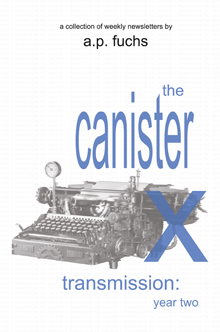
  • The Canister X Transmission: Year Two

    The Canister X Transmission: Year Two

    The Canister X Transmission: Year Two

    Begin transmission . . .

    Running weekly from May 2015 to April 2016, The Canister X Transmission was sent via email to readers worldwide.

    Every week, readers received updates from the desk of A.P. Fuchs that served as a behind-the-scenes gateway into his views on the publishing industry and past work.

    The newsletter covered four main topics:

    Writing/Creating/Publishing, in which Fuchs shared his views on writing and creating as well as tips to help other writers and artists along their journey.

    Project Analysis, where A.P. discussed his extensive backlist and what went into each project.

    Creator Spotlight, where a variety of writers and artists were given the spotlight as well as their professional and personal impact on Fuchs and his work.

    Weekly Ramble, in which whatever happened to be a point of interest that week became the topic of discussion.

    Exclusive to this collection is a special Issue Fifty-three A newsletter unavailable anywhere else.

    Welcome to The Canister X Transmission: Year Two

    Available as a paperback at:

    Amazon.com
    Amazon.ca
    Amazon.co.uk
    Barnes and Noble

    Available as an eBook at:

    Amazon Kindle
    Drivethru Fiction
    Smashwords

    Please visit here for Year Three. Enjoy!


  • Axiom-man Revision Underway

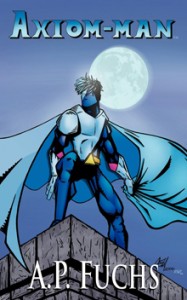
    axiommandrivethruI’m a great deal through revising the original Axiom-man novel and prepping it for the 10th-anniversary special edition that’s coming out in the fall.

    It’s like going back in time. Not only do I get to revisit the story, but I also get to revisit myself because it was written when I was 25 and still new at this writing game. I was a very different writer back then so my mission with the revision isn’t to do a complete overhaul, but maintain the voice of that 25-year-old while updating the text to match the writer I am now.

    The special edition will not only contain the revised version of the story, but a lot of bonus material, too, which will be revealed at a later date.

    Whether you’re new reader or have been following The Axiom-man Saga since the beginning, this is a book you’ll want to add to your collection once it’s released.


  • Reflections on Working as a Full Time Writer

    Reflections on Working as a Full Time Writer

    Zombie Fight Night on the Keyboard

    General Thoughts:

    Since about the spring of 2009, I’ve been working full time as a writer and publisher. There have been a couple out-of-the-house gigs here and there since 2014, but otherwise I’ve been on my own. Even after the past seven years or so, it still all feels kinda new. If you know my journey and all that went on behind-the-scenes, you know it hasn’t been an easy road, so to finally be able to live my creative dream after all those obstacles is surreal. There are days I feel like I’m doing something wrong; decades of being conditioned to think that all jobs need to occur at a place of business instead of in a home office still creeps into my brain once in a while. Calling my own shots and my own hours is something I’m still getting used to even after years of doing it.

    On Working for a Living:

    I’ve never been opposed to working for a living. I believe everyone needs to earn their own way through life and not live on handouts. To clarify, “earning their own way” is meant as don’t be one of those people who sit around all day or count every day as play time. A person needs to work and that doesn’t necessarily mean at a job-job. If you’re a stay-at-home parent, you have my admiration because I did the stay-at-home dad thing for a long time and know how hard it is to maintain a home plus take care of a couple rugrats. Actually, stay-at-home parents work harder than anyone else if you count all the tasks and stresses associated with it. They make a living for everyone else around them even though they don’t collect dollars and cents every two weeks.

    The world owes you nothing.

    Nothing.

    If you want something, you have to go and get it.

    On Living Without a Regular Paycheck:

    My needs are small and, in recent years especially, I’ve become something of a minimalist in terms of being content and fulfilled by the basics: food, shelter, clothes, a means to work. All the rest is window dressing, and I don’t chase the dollar sign nor do I want a rich lifestyle. Heck, I go to some friends’ houses who are way more well off than I am and within a few minutes I feel out of place. Same with fancy restaurants or venues. I get uncomfortable. I’m good with my 110-year-old house with a crappy paint job and holes in my socks.

    But in terms of working without knowing where the next paycheck is coming from, I’ve gotten used it and I’ve always been provided for even when I’ve hit lean times now and then. The basics have always been met and, at the end of the day, those are the most important.

    Living without security has also taught me to ensure I get my butt in gear and produce books and items to keep those books selling which, when the payday comes, makes it even more rewarding than a guaranteed salary because I know had I not made the effort to move the books, I wouldn’t be able to buy my next box of cereal.

    It was a hard leap to plunge into what was essentially the world of sales and commission. When you’re used to a regular 9-5 and have been brainwashed by everyone in your circle that security is the way to go, it was a challenge to start working without a net.

    Nowadays, I like the thrill of the chase. Even as I type this, my June is up in the air monetarily speaking, but I know I’ll be okay once it rolls around.

    On Community:

    The greatest reward is the creative community I’ve plugged myself into over the years. If I were to corral the people together into categories, they fall into two major groups: my on-line horror buddies whom I spent hours and hours with over the computer back in the early days, and the second group is a local one I started getting involved with in the fall of 2014. (Social media killed that first one.)

    Writing is an incredibly lonely job. It’s fun while you’re doing it and is best done by yourself, but when you’re doing all the peripheral tasks of independent publishing, it can get lonesome sitting there at a computer all day. Having a group to connect with now and then in the real world has enabled me to get out of the house and be an off-line human being. It has filled me up in ways digital connection cannot, and since I’m generally opposed to living my whole life on the Internet, has been quite welcome.

    Final Thought:

    I don’t know what the future looks like creatively-speaking. Truthfully, I don’t want to know. But what I do know is come the day I’m lying on my deathbed, I get to lay there and look back over my career and know I had a fulfilling working life doing what I love on my own terms. That’s something money can’t buy, is something I can take with me as I leave this world, and an example I can leave behind on what it truly means to be rich.

    But for now, I’m content working as a full time writer.


  • Why I Quit the Publishing Industry and Opted to Just Make Books Instead

    Why I Quit the Publishing Industry and Opted to Just Make Books Instead

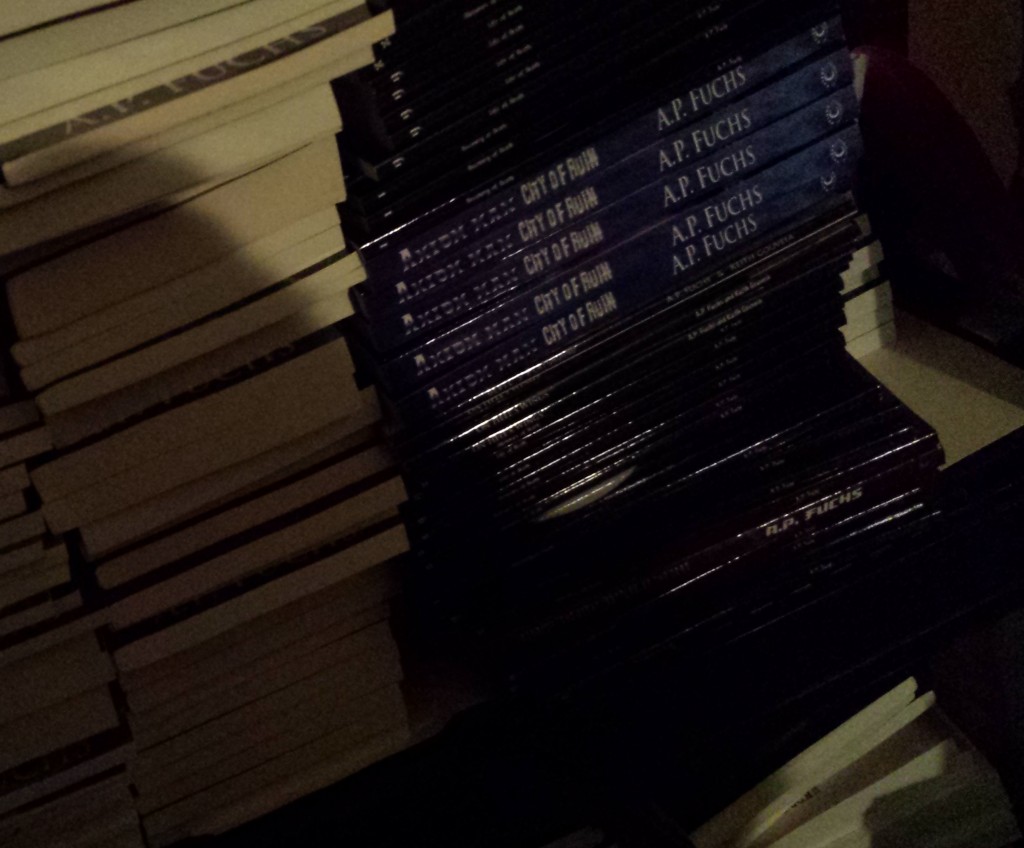
    Bookshelf March 16 2016 - Publishing Industry

    Well, we’ve really done it, haven’t we?

    And we’re all to blame, every one of us.

    Writers, editors, publishers, marketing departments.

    Indie or traditional, we’re all guilty.

    Some call this the Golden Age of Publishing and the best time to be a writer.

    Still trying to figure out why. That is, why in the truest sense. Sure, the arguments are it’s easy to get your work out there and some of have made a goldmine. That’s not reason enough to give this era of publishing the labels we have.

    For those who don’t know, I started writing my first book in 2000. I published it via a vanity press in 2003. Starting in 2004, I began self-publishing all my novels through my own company, my traditional “outbound” sales being short stories. Being independent back then was considered taboo and the kiss of death. If you publicly declared you published your own work, at least in writing and publishing circles, you weren’t a real writer and eBooks weren’t real books. You weren’t even a real publisher.

    It bothered me for a few years, but then I didn’t care and proudly flaunted what I did. If you didn’t like it, too bad.

    I made a name for myself in small press circles and became a minor local celebrity. Back in the beginning, back when I was writing that first book, there were a couple of months where I dreamed of fame and fortune. Not anymore. Don’t want it. But that’s another blog entry.

    As my career progressed, I’ve seen writers come and go, publishers rise and fall, and the industry drastically change. I’ve made amazing friendships and networked with so many people, some of whom are very well known. I’ve stuck to the small press by choice and have dealt with the major league publishers while my publishing company was in full swing and I worked with other authors.

    These days, I’m alone again. By choice. My meltdown in 2014 led to that and, in some ways, I’m still recovering.

    That’s a quick history of where I’m coming from.

    Back to why I decided to quit the publishing business: to be honest, I won’t no part of it. Not in the way it is right now. Over the past few weeks I’ve spoken to a several writers about how things are going. I’m paraphrasing, but they all said the same thing: not very good. Can’t get readers.

    Over the months and recent years leading up to this past little while, I’ve heard the same thing. It’s getting progressively harder and harder to reach people and books can no longer–for most–be one’s sole source of income. And I’m not even talking massive money, to be clear. For many, making a thousand bucks off one’s books in a year is doing well. But to make a livable wage of, say, twenty or thirty thousand? Forget it.

    Sure, there are genre exceptions. Erotica’s a big one. I know a guy who’s main love is horror, but that doesn’t pay the bills, so he writes pornographic books to make up the difference. Certain romance genres are also big. But other genre fiction from average Writer Joe? Forget it.

    The market is flooded. Everyone is publishing a book these days, quality be damned. And those who do put in the time and effort and monetary investment for quality are just nameless voices on the wind. Some said the cream would rise to the top. I have yet to see it, and that statement was made years ago.

    Heck, some readers are stopping reading independent titles altogether because they’ve been let down too many times. You don’t have a name that’s recognizable and one that can be counted on to deliver the goods? Back of the line, please.

    That opening line to this entry? It’s true. Here’s what happened:

    A certain on-line juggernaut was a good place to get books. There were many others, but this big on-line place was a favorite. They offered a few breaks, saved you some shipping, discounted things by a couple of bucks. It became a common place to refer people to. We all sent them there. Over and over again. The company grew–exploded–and came out with their own publishing platform. That caught like wildfire and stories of near-instant millionaires tickled the ears of writers everywhere. A little more time passed and everybody was publishing and everybody was referring people to this one place. Meanwhile, over the years on the side, other companies couldn’t compete and started shutting down. (Ever wonder why you go into a bookstore and a good chunk of it is dedicated to things other than books? There you go. Or what of the smaller publishing houses whose main bread and butter is government grants and not book sales?) Options became limited. And us writers kept pushing one platform, one retailer. Throw a flooded market on top of that and now things are falling apart.

    (And you know it’s bad when you have big shot agents in NY telling you to self-publish instead.)

    Writers don’t know what to do and fail to realize they’ve ruined their own careers by betting the majority of their chips on one avenue. Mankind’s shortsightedness, right? Look at other writer blogs that talk about writing and publishing. What are most of the articles about? How to sell books, score big at a certain on-line place, manipulate charts and cheat your way to the top all in the name of the almighty dollar.

    Greed.

    Pride.

    Foolishness.

    Oh sure, even if you’ve scored massive right now–who cares? You’re screwing Future You. If you’re really in this business for the right reasons–that is, you’re an artist and need an outlet and want to share it with people while supporting yourself at the same time–you should know by now this is a marathon not a sprint. Yet writers are sprinting and scrambling and are getting frustrated all the while not paying attention to how their actions today will affect themselves tomorrow.

    Samhain Publishing is the recent high profile case of a publisher closing its doors. The reason? Like all businesses that have to say goodbye, they couldn’t fund the operation anymore. If you read their letter, which is on-line, the bulk of their sales came from one place and, when that market became tough, the money was no longer there to keep going.

    Side note: Even those who are making a killing at this–it’s not a killing at all because they have one main outlet, even one main format. Take that away and what’s left? Not much else. That’s not success, in my opinion. Yours might be different. Success in publishing comes from doing well in the majority of the markets, not just one. Anyway . . .

    Speaking generally, the mad dash for the dollar is the main culprit. Greed is the fall of mankind.

    I was at a bookstore recently and I was disgusted by what I saw. Nearly every book on the shelf looked just like the one next to it. Not a single one caught my eye. Sure, some had neat-sounding titles, but strictly the covers? It’s like walking into Moore’s to buy a suit. They’re pretty much all the same save for a few differences in how the lapels are cut. But that’s marketing. That’s the big machine brainwashing people into telling them what they want. Romance covers look like this, thriller covers look like that.

    Of course I realize I could very well be alone in this. My tastes are more into the unusual and books with covers that show genuine creativity and break boundaries are what get my attention. This goes for my comic book tastes, too.

    So again, the machine, the big ocean of publishing. I’m just one measly fish in all this but everyone else wants to cater to the masses. They forget that we programmed the masses to accept things a certain way by doing things a certain way over and over.

    Even books. We have genres. When a book’s genre is a snap to define, it’s marketable. Ask any writer who’s queried an agent or publisher. Have a different style of book where genres–even mediums–merge and it’s much, much harder. Seems we forgot people simply like stories and have instead forced those stories into little boxes. Romance here, thrillers there. This puts writers in boxes, too. Write a book that’s gonna sell. Another common mantra. So you write to genre, even to formula. That’s what readers expect, after all. Don’t shake things up. Don’t create anymore. Just follow the recipe and hopefully your cupcakes will turn out well.

    I got into this business all those years ago to tell stories. Being green and naive at the time, I knew about genre but didn’t know about genre. And, yeah, I’ve partly catered to it as time has gone on. Even played the money game and published what was popular. It was all unfulfilling. The extra bucks in my pocket didn’t fill that gap in my heart, the one that needed to express itself through simply telling a story.

    Over the years, I’ve tried to do new things in my fiction. Even my zombie stuff has gotten blasted because of some of the non-formulaic stuff I threw in there. Wanna give me a one-star review for that? Put me down. Or the first Axiom-man book. It’s a slow burn because I based it on real life and played it out as if the storyline happened in our world. No fast-paced Hollywood hero stuff.

    There were even times over the years where I was obsessed with landing a mass market deal so I could “make it.” There were other times where all the joy and fun of creating was gone and my books became a product and I was a factory. And, man, when a book loses its heart–it’s not a book anymore. Just words on a bunch of pages. That’s empty. That defeats point of even creating to begin with.

    These days, all I’m seeing is the majority of those in the business thinking nothing of the craft itself and instead thinking of the endgame, the product, the dollar. Search writers’ groups or your Twitter feed. Article after article on “formulas for success,” or “how to write a book that sells.”

    The immediate cash grab.

    (These formulas are all BS, by the way. There is no one right way because if there was, the secret would’ve gotten out by now and we’d all be doing it.)

    Authors are panicking because most rely on on-line sales and, well, there’s really only one place for those now, isn’t there? You remember whose fault it is.

    Just living in the now. Screw the Future You and, for quite a lot of you, you are that Future You right now and you’re taking it hard up you-know-where.

    As said, we’re all guilty.

    —–

    To wrap up, I just don’t want to be part of this business as it is. I don’t want my own creativity to be limited by outlet or genre. I don’t want to be an author brand or that writer who only does one thing. The point of art is to create without limits. Pick your medium. This is where you say, “Well, that might be, A.P., but if you want to survive in this business you have to play by the business’s rules.” And you’re right . . . but you also forget it’s actually us writers who make the rules.

    Except no one is going about trying to change them. A publisher is useless without you, remember?

    Imagine if we all started doing our own thing. Imagine if we didn’t play to genre or one platform or manipulate systems and writers everywhere flooded publishing offices with manuscripts that were excellent heart-filled stories that didn’t fall into a definable category. Chaos at first. A whole slew of rejections. But if it kept happening? The powers that be would have no choice but to take a second look and revise how they do business.

    Or . . .

    Imagine if every writer marketing their work got their heads around the truth that fostering box stores–on-line and off- –is a bad idea, and instead of handing their literary destiny over to a single entity, they diversified. Hmm . . . what if they led by example? What if their own purchases for anything in their lives were made outside the giants? What if they steered their readers toward direct sales or other outlets that don’t get as much attention? Small businesses would thrive again. Perhaps, even, people in general wouldn’t be corporate cogs and we’d all have fulfilling lives in terms of how we spent eight hours a day and the rewards we reaped from it beyond just the dollar sign.

    For years I said if the publishing industry continued down the path it was on, it would start to break. Now it’s happening. I know many writers who used to support themselves on their writing having to go and work outside the home again. I know of many small presses closing up shop because they can’t sustain themselves off of books.

    It seems creators in any medium don’t understand they hold all the cards. We can change this. We’ll need to take hits along the way and some will be financial. You’ll have to part with your precious cash. But in the long term? That Future You? They’ll thank you.

    As for me, I’m out. Gonna march completely to my own drummer now. Do things my way. Tell the stories I want to tell genre be damned. Break some rules. Put out books with covers that are simply cool instead of falling into marketing cliches. Even mix mediums and put out illustrated novel/graphic novel hybrids. These days I don’t rely on that on-line empire for my sales. Off-line and direct work very well for me. And this is good. If all my cards were in one deck and that deck goes away–and yeah, it could happen, guys, unless you know the future and aren’t telling me something–I’d have nothing.

    Anyway, you might call this career suicide.

    I call it career resurrection.

    I’m in this to be honest with my work, to be honest with who I am as a person, to be straight up with you and to be the real deal. Might also being the only guy doing it, too, which is fine.

    But, man, what a payoff.

    I’m not publishing books anymore. I’m making them. To publish them connects me to a business that’s dying. To simply make them and make art connects me to something that’s alive.

    I quit the publishing industry.

    And that’s so much better.