

Just finished up Smashwords’s author self-interview and it is now live.
You can read it here and it covers a whole bunch of topics.
Thanks.
 Canister X – A.P. Fuchs
Writer, Artist, Creator
Just finished up Smashwords’s author self-interview and it is now live.
You can read it here and it covers a whole bunch of topics.
Thanks.
 My Writing Process – Don’t Really Have One
My Writing Process – Don’t Really Have One
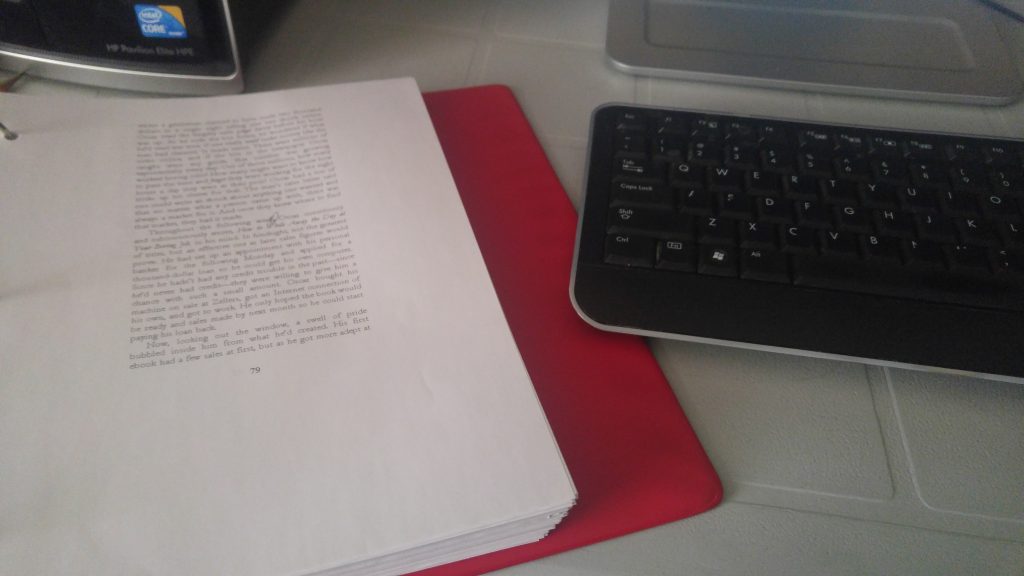
For some reason I’ve recently been giving a lot of thought to my writing process and I came to the conclusion I don’t really have one. At least, not in the conventional sense when someone thinks about how an author writes a book. Usually it involves notions of slaving away over the words, crafting each sentence to perfection, doing rewrite after rewrite, line editing, copy editing, proofing and so forth.
None of that applies to me. Not in that sort of depth, anyway.
My first book, A Stranger Dead, and from what I recall, involved a lot of that: slaving away over each word. Being a first book and first effort, that’s how I thought book writing was done. And, hey, if that’s how you write your books, by all means, whatever works, right?
But for me, I’ve been following the same writing process for at least a decade. It’s bare-bones simple, and doesn’t require a lot of brain power other than the first draft, and even then, I’m not exhausting my mental energy to the point of being brain dead after a writing session.
Though there are exceptions, this is typically how I write a book:
– A title or basic premise comes to me
– I let it stew in the back of my head so my subconscious can work things out without me consciously thinking about them
– The first line of the story comes to mind
– I get to work on the first draft
On the first draft:
I’ve only outlined a book once, and that book is still in process as of this writing. I will also be outlining another book to finish it off because it involves time travel and I got myself into a possible paradoxical mess with the thing so I need to iron out the details so it’s paradox-free (something that’s very important when writing time travel stories). Other than that, I simply write a book as it comes to me, scene by scene, sentence by sentence, word by word. I don’t think about what I’m writing. I just write it as I see it in my head and that’s it. I’ve written enough books over the years to know the golden rule that every word needs to serve the story, so I don’t have to worry about scenes being cut later because they’re just fluff.
And that’s it. I write the story start to finish and do not edit as I go along.
Sometimes I know how it’s going to end, sometimes I don’t. Sometimes when I do know how it’s going to end—and since I let the story tell itself—that ending either doesn’t happen or doesn’t happen how I originally envisioned it. But whatever. I let the story do the talking, not me.
After the first draft is done, I run a spellcheck and print it out.
I leave the book alone for a while, sometimes a week, sometimes a month, then get to work on the second draft.
On the second draft:
By leaving the book alone, I had a chance to mentally distance myself from it before going at it with fresh eyes.
You see, you write and read at different speeds, so while taking my pen to my first draft, I read it at a reader’s rate and am able to smooth out choppy sentences or catch words I repeat—every writer has a go-to word or phrase in their first draft—and make sure story continuity lines up. It’s this latter point that always astonishes me: the way your subconscious keeps track of everything between writing sessions and keeps the story in order. I might add a sentence or two or delete a couple redundancies. Nothing fancy.
I then type up my second draft edits and print the book out again for draft three.
On the third draft:
This is the polish draft, and after having done a solid clean-up on it in draft two, this draft is a way to catch anything I missed the first time and do a spit shine on it. Seldom are any substantial changes made. Again, it’s done at reader’s rate so I just read along and tweak things here and there.
These changes are typed up and the book goes off to my editor.
I wait for the editor to do what I pay him for then get the book back from him.
On the editor’s draft:
At this point I’m already getting sick of my own story after having been through it three times, so all I do during this phase is go through my editor’s edits and only his edits. I agree with 95% of them; the remaining 5% are usually matters of taste and preference and not actual errors.
My editor’s work is now complete. He gets paid, and all he has to do is await his editor’s copy in the mail when it’s ready.
I take the editor’s draft and do a three-quarter format on the book.
On the partially-formatted book:
The book is now resembling what the reader will eventually see in terms of layout and trim size. Chapter headings are decorated and basic front and back matter are put in place. The only thing that’s really missing are the headers and footers.
I print it out.
Since I consider my editor’s draft draft number four, this partially-formatted book is my fifth and final draft in which I go through it and catch anything my editor or I might’ve missed. What’s helpful about this stage is the new layout of the book. There are less words per line at a 6 x 9” trim size than your standard 8.5 x 11” piece of paper. Things read differently and any error seems to jump out all the clearer.
These mistakes are fixed and are typed into the computer.
I then go on to finish the book with its final bells and whistles.
On the bells and whistles:
These include adding the headers and footers, the title cards and any ad matter in the back.
At this stage, it’s just an issue of making sure all the formatting is in place, and the book itself is done.
Paperback formatting is always done first, then the various eBook formatting required for the different platforms comes after.
On the off-chance I catch a mistake while formatting, I then have to sort through the different files and make the change in each. It’s annoying and a pain but has to be done.
Then that’s it. It’s off to press.
Of course, during the preliminary format I get my page count thus can create my cover, but that’s not the topic of this post.
But that’s my process. Five total drafts, four of which are mine.
A long time ago a writer friend gave me the greatest bit of publishing advice I’ve ever received. I’ve repeated it a bunch of times to writers in all sorts of forums and venues over the years, and it’s this: it’s only a book. And that’s how I treat my novels: they’re only books. That’s all they are. They’re stories. They’re fantasies. They’re entertainment. Like I always say, kingdoms won’t rise and fall based on something I’ve written so I’m long past the stage of obsessing over my stories.
I just write the damn thing, clean it up, then share it with you.
That’s the writing process, if you want to call it that.
That’s it. Thank you. Good night.
 Canister X Book Review #6: 1001 Ways to Market Your Books: For Authors and Publishers, 5th Edition by John Kremer
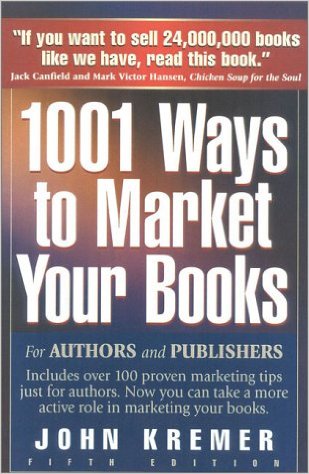
1001 Ways to Market Your Books: For Authors and Publishers, 5th Edition
by John Kremer
5 out of 5
This review is for the fifth edition of this book, though I suspect that the fifth and sixth editions are virtually the same save for a bit of info here or there.
Writing a book is easy. Getting it out there is hard. It’s a challenge for both the big, small and self-publisher alike. 10% of your time and energy goes into creating your masterpiece, 90% goes into bringing it to the masses.
In 1001 Ways to Market Your Books, author and publisher John Kremer walks you through step-by-step 1001 effective methods to market your book.
This doesn’t read like a manual or some textbook. Kremer’s professional yet personable writing style keeps you interested and forces you to pay attention to everything he has to say.
This book is so dense that you can’t just read it once then call it good. It’s a resource, which means it’s meant to be visited each time you publish a book so you can pull out some of the 1001 marketing methods offered.
Don’t try doing all 1001 things suggested in this book all for one title. It won’t work. Kremer even says so in the opening pages. The idea is to cater to your particular book’s needs and find the marketing methods that work for that specific title.
Kremer backs up his info with industry stats, gives examples of what’s worked for some publishers and what’s failed for others.
Take notes while you read it. Even jot down in separate columns on a loose sheet of paper what ideas would work for the titles in your company’s catalogue and mark down the page number in Kremer’s book for each.
This is a book every serious publisher needs to have on their shelf. More importantly, it’s a book they need to use.
This is the official website of Canadian author and cartoonist A.P. Fuchs.
I’m the author of over 30 books with more being created all the time. I write from Winnipeg, Manitoba, and am in the midst of a ton of deadlines, which is why this website will be quiet for a while. My main conduits to the outside world are Twitter and my newsletter, which is sent out weekly. To keep up-to-date with me, those two are your best options. I do pop in on Facebook once in a while, but will be scaling that back as I work off-line to finish a couple manuscripts and start some new ones.
I bid you all well. Keep warm this winter.
 Why You Should Self-publish Part Two
Why You Should Self-publish Part Two
(from Getting Down and Digital: How to Self-publish Your Book)
By taking on the role of a publisher, the one who fronts the cost to turn a manuscript into a published book, the self-publisher takes all the risk—but also reaps all the reward as a result. Think of it as an investment. Folks go to the bank all the time and dump in fifty dollars, a hundred dollars, a thousand or more into RRSPs or GICs, money they’ll never touch for years, but while it’s sitting there, it’ll earn them much more than they originally invested given enough time. Self-publishing is the same way. Even if your up-front costs are a thousand dollars, you start selling your books and, depending on format, make $3-10 profit, once you’ve sold 100-333 copies, you’ve made your money back. Everything above that is your return on your investment. And instead of making a dollar or even two dollars a book sold as per the traditional royalty system with the rest going to your publisher—and to be fair, they deserve to make money for bringing the book to market for you and taking care of you during your contract with them—you get to keep all the profits for yourself.
There’s huge potential to make a lot of money self-publishing. Like I said, if you set up your system to ensure you make $3-10 profit per book (i.e. $3 minimum on an eBook sale and $10 or so on the high end for a paperback sale), you could come away with a very secure future assuming the market is kind to you. To sell 50 eBooks would pay my water bill for three months. I could do the same if I sold 15 paperbacks at a convention as I average around $10 profit per sale through those direct-to-reader venues.
Before, a writer would have to sell thousands of copies of their book just to stay afloat because they made anywhere from 80 cents to a couple bucks a book depending on format. Sometimes less. And while it’s great that they sold those thousands of copies so they could pay their bills, imagine how much more they could’ve made had they been able to do the same volume of sales on their own? If they sold 2000 books total and made the aforementioned 80 cents to two dollars, that would be around $1600-4000 in their pocket. If they self-published and averaged $3-10 per sale, that’s a range of $6000-20,000 to their credit. A huge, huge difference, and for some, enough of a difference between having a bed to sleep in and food on the table.
The beauty of self-publishing is the ability to produce a book for a niche market, something that you don’t typically find in the mainstream, if at all. For example, I write superhero fiction. Back when I started doing it in 2006, my series, The Axiom-man Saga, was one of a handful of other independent superhero fiction books. There was no way I could take my manuscript and sell it to a publishing house because no one would take the risk on a completely unknown superhero with no proven track record. Well, guess what? By self-publishing the series, I’ve been able to find an audience for it and every time a new installment in The Axiom-man Saga comes out for a convention or on-line, people buy copies. And when I’m behind on getting a new book out because I’m committed to other projects, people start asking me when the next book in The Axiom-man Saga is coming out.
Self-publishing is also great for those who can’t keep their hands to themselves. Some writers need to be involved with their book every step of the way, and while this goes back to self-publishing enabling the writer complete control of the project, it also lends itself to writers who are also entrepreneurs, who are business people by nature.
There are two types of people in the world: those who take risks and those who don’t. Entrepreneurs are risk-takers. They see the potential for a business and are willing to spend the money—sometimes money they don’t have—to make it happen even though there’s the possibility it might not work out. And that’s their mindset when it comes to self-publishing: it’s a business. And what do businesses do? They manufacture a product and market it to people. Even service-providing businesses do the same because a service is a product. The entrepreneurial self-publisher is someone who isn’t just a creative individual, but also one with a business-oriented mindset, someone who has a vision for their book beyond simply writing it and are willing to take the risk(s) involved to make that vision a reality. While I personally don’t view books as “products” but works of art, from the outside looking in that’s what a publisher does: sells a product.
The other advantage to self-publishing is to take a book and prove to a traditional publisher there is a market for it. There are many stories of writers self-publishing rejected manuscripts—which weren’t necessarily rejected for quality reasons—and turning them into bestsellers. There are also those who have self-published, had major success, and then were picked up by a traditional publisher who took on the publishing duties of the same book. Often, these publishers paid a lot of money to have these books in their catalog because the writer showed them there’s an audience for their book(s) out there. You need to sell several thousand copies to catch a traditional publisher’s interest, something to the tune of 5000 copies-plus, but self-publishing is an excellent way to give a chance at life to a book that otherwise would’ve been sitting in a rejection pile somewhere.
By self-publishing, you are also the sole rights holder to the book. And while true even if you sold the book to a traditional publisher you’d still be the sole author and copyright holder, the traditional publisher would be the one who holds the print and electronic rights to it, meaning they could be the only ones to publish the book in the language they represent. Depending, some traditional publishers take additional rights when taking on a book: audio, film, even foreign translation rights if they are connected in that way. The first two are the most common. By going it alone, you decide who gets what, so if some guy from Hollywood wants to make a movie out of your book, you don’t need to share the monies offered with anyone if you negotiate the deal yourself. You’d also get to decide how much influence you’ll have on the movie, though, of course, if you want too much influence—and how much influence is “too much” is up to Joe Hollywood—then the deal might not happen at all. Regardless, to be the one in charge of deciding what other ways people can experience your story is up to you if you self-publish.
If you’re a salesman or are good with people, then the marketing of self-publishing should excite you. For some, sales are a thrill-of-the-chase thing and for every sale they land, they get a high off it. And to know that for every hour of effort you put into selling your book will reap you and you alone the financial reward of doing so should make you even more excited. Books usually don’t sell themselves, but if marketing and creating campaigns is an area of interest for you, self-publishing is an excellent field to do it in.
As you can see, there are numerous advantages to self-publishing your book, the main ones being control and the potential to make more money. You also get to bypass anyone who might reject publishing your book and just take it directly to the reader themselves and let them decide.
But most importantly, self-publishing is a ton of fun and I love every minute of it. Unless a traditional publisher comes along and can do something for me I can’t do on my own, then I plan on self-publishing for the remainder of my writing career.
Having too much of a blast doing so.
Maybe you will, too.