This entry was prompted because I’ve come across it more than once. Three times, to be exact, so I figure it’s worth blogging about.
Authors and starting their own publishing company.
This is the approach to publishing I strongly advocate in Getting Down and Digital: How to Self-publish Your Book. It’s my opinion that taking the time to set up a publishing business the proper way opens doors to taking your self-publishing career in multiple positive directions, on-line and off-.
But can you just start a publishing company? On three separate occasions I’ve seen authors simply “start companies,” that is, just making up a business name and start and/or plan to publish under it without registering it through the proper channels.
While the nuances of business start-up rules vary country to country, state to state, province to province, if a person wants to start a company, there is a certain way to go about it because each industry functions on different rules of trade and sales depending on where you live.
When I started Coscom Entertainment and any if its imprints, I had to go to the Companies Office downtown, fill out paperwork, explain what my business was and pay a fee. This was in Winnipeg, Manitoba, Canada.
I know from speaking with other Canadian and US publishers that they, too, had to go through a formal procedure to get their company up and running.
But I have also seen authors pull a company out of thin air and aim to start using it. I don’t know if this is simply because they don’t know any better or if it’s because of all the Kindle talk that people think all areas of publishing are free and one can do whatever they want when it comes to it. Or maybe, like most writers and artists, money is hard to come by so they want to do things as cheaply as possible and free is about as cheap as it gets. Perhaps it’s the Internet mentality because a lot of people view the Web as a “place to get stuff free” so why not start up a company for free, too? The problem with this kind of free is it’s unethical. Why create the groundwork of your career on something that’s wrong? It’ll only lead to problems down the road.
The publishing industry is changing, this is true, and things are not what they used to be–and this extends past the whole eBook thing–but other things have remained, and that is the need to properly start a business if setting up a publishing house is part of your self-publishing plan.
If you’re not sure what to do, pull out your phone book and look up your local Companies Office. Tell them what you plan on doing–publish books–and they’ll let you know what you need to do so that if your business is ever looked into, you can produce the proper paperwork that states you are allowed to run your business whether out of your home or an outside office. Likewise, when it comes tax time and you claim your writing income, claiming it under a company might work to your advantage in terms of write-offs. Talk to an accountant about this as the rules vary place to place.
In the end, if you wish to self-publish via your own imprint, part of the deal is registering that imprint with the proper authorities.
Start your career on the right foot. It can only payoff in the end.
Note: This post was originally published on Jeffrey Allen Davis’s blog
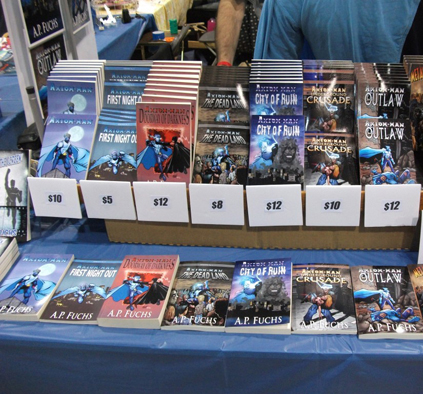
The Axiom-man Saga at the C4 Comic Con 2013
The Axiom-man Origin and Why I Write Superhero Fiction by A.P. Fuchs
The Axiom-man Saga is an old story. A couple decades, in fact, as it was around then that I started to daydream about a similar hero while walking my paper route each morning. I’d get so lost in this story about a hero caught in a cosmic war between Good and Evil that I’d be done my route before I knew it and would often run house-to-house to double check and make sure I delivered the paper to the right places.
In that fantasy, of course, I played the hero. As the story grew and I got older, I ended up transferring the honor of being that character to someone else, a fictitious someone else who would one day go by the name of Gabriel Garrison.
Axiom-man began to take shape in concept throughout all my years of delivering the paper—and went by a different name, which was featured in my novel, April, written as Peter Fox (for that secret name, you’ll just have to read the book to find out). In 1995, Axiom-man received his new costume, the one he wears today. At the time, Axiom-man—originally called Trinity—and this concept character of mine were two different people. Trinity was more of a supernatural hero ala Spawn and fought demons, whereas my other hero was more down-to-Earth in nature and had very Superman-like powers. Yes, I know: Superman isn’t very down-to-Earth, but he does deal with things on this plane of existence 9 times out of 10. Anyway, as time went on, Trinity became Axiom—who was yet another character at the time—and as even more time went on and after being inspired by the likes of Frank Dirscherl and his Wraith character—who back in 2005 had one novel, a comic and a movie in the works—I decided it was time to put my long-thought-about superhero to paper. I merged my paper route fantasy character with Axiom because I always had an affinity for him, and after doing a quick web search on the Axiom name and finding a company out there with the same name, I went and made it my own by adding “man” to the end of it, hyphenated, of course, because that’s who Axiom-man really is: a self-evident truth embodied in a single person, in his case the self-evident truth of being one to do good rather than evil. From there it was an issue of scaling his powers waaaay back and settling upon three of them: strength, flight and eye beams. And when I say I scaled his powers way back, I mean way, way back. When Axiom-man debuted, he could only lift around 1000 pounds, could fly at about 60 kilometers an hour, and his energy beams only carried so much force. I didn’t want to make him too powerful thus making him always the winner and, because of his great strength, have no choice but to always pit him against ultra powerful foes. My story was to take place in our world under the idea of, “If this happened in our reality tomorrow, how would it most likely play out?” Making him with that kind of power set helped keep him grounded in reality and gave me plenty of options for enemies he could fight to sometimes win and sometimes lose against.
His backstory and mythology were left unaltered and kept the same as the character I thought about growing up, still the product of a nameless messenger having visited him and granting him his abilities without explanation. As the story goes on, Axiom-man finds out why he received his powers and how he is caught in a cosmic war that has raged since time immemorial.
The reason Axiom-man made his debut in books rather than comics was because, at the time I brought him to market, I knew of superhero fiction but didn’t think to do it independently. Frank Dirscherl’s The Wraith and Knight Seeker by Eric Cooper showed me otherwise. Axiom-man was originally a comic book character and I even drew a 21- or 22-page comic with him when he was called Trinity back in high school. I still have it somewhere and might publish it one day as a kind of behind-the-scenes thing. Anyway . . .
By doing superheroes in prose, I was able to work alone, could tell the story exactly how I wanted it, and because I was already self-publishing other fiction at the time, had the system in place to get Axiom-man out there.
You know, even though Axiom-man was my first official superhero release, I look over my fiction and every book I’ve written is a superhero novel in some way. Take A Red Dark Night, for example. It’s about a summer camp under siege by blood creatures. One of the protagonists, Tarek, is superheroic in nature, wears an otherworldly outfit complete with a cape, and shoots blue fire from a gauntlet on his forearm.
My epic fantasy book, some quarter million words long, called The Way of the Fog, is about a group of people who get superpowers in a medieval/fantasy-style setting.
My zombie trilogy, Undead World, deals with the supernatural, time travel, and each character is superheroic in how they act, even archetypical in some cases, with comic book-like good vs evil action.
Zombie Fight Night—aside from an aged Axiom-man making an appearance in there, is full of comic book characters monster-wise, everything from werewolves to vampires; to robots to pirates; to ninjas to samurai; and beyond, all battling the undead.
The Metahumans vs anthology series is, obviously, about Metahumans aka superheroes fighting a themed foe throughout each book.
As mentioned, my love story, April, is about a comic book writer who’s fallen in love, and what does he write? Superhero comics.
I think it’s only fitting that superhero fiction in its truest form—an actual superhero storyline—became a part of my repertoire. It seemed inevitable considering my love for the genre. Ever since I knew what a superhero was—at three years old, I think—I’ve been hooked, and not a day in my life has gone by where I haven’t thought about them, theorized about them, fantasized about them, pretended to be them and more. I even wear Superman and Batman onesies to bed for crying out loud!
Calling me a geek is an understatement, but I don’t care. Geeks make the world go round and fanboys are the ones providing people with entertainment. Superhero fiction just happens to be my main venue for doing so.
And where is Axiom-man going from here? Well, thus far, 7 prose books have been released along with a few comics and short stories. The whole saga is planned to be 50 books long, so I’m coming up on being 20 percent finished. The good part is the story is pretty much all mentally written. I had 9 years or so of delivering papers to get the story right, after all.
What I’m enjoying about the superhero fiction format is I’m able to do things with my characters that comic books don’t allow, at least, current superhero comics don’t allow. I’ve long advocated—and still do—that the comic book is the greatest storytelling medium to ever come down the pike, with books being a close second. Why? Because it’s the one-two punch of pictures combined with narration, whereas prose is a text-only medium. I still believe that, but being that at this stage in my career I’m primarily a writer versus a writer/artist, I’m sticking to books and the book medium is capable of telling superhero stories in a way comics haven’t as yet, namely getting inside a character’s head. Very few comic writers have succeeded in that in the past. Superhero comics are far too picture-heavy these days, with flashy computer coloring jobs, flimsy stories and scant dialogue. I miss the old days where there were almost equal amounts of text and pictures. At least with The Axiom-man Saga as it stands now, I can bring the reader dense characters where every thought and feeling is brought to the fore and, hopefully, pull the reader into the characters’ shoes in a way that superhero comics don’t. That’s my main goal with this: bring the reader in so that they feel they are experiencing my fiction versus just reading it. I’ve yet to read a superhero comic where this has happened. I have, however, read superhero books where this has occurred, Batman: Knightfall by Dennis O’Neil being a major favorite of mine and my first foray into the superhero fiction world.
What also sets The Axiom-man Saga apart from any of the current superhero offerings is that it’s a cross-medium superhero story that encompasses books, comics and short stories, all part of the same continuity. This has never been done before, and putting new spins on old things is one of the things I’ve always striven for in my fiction, especially in this industry where things are pretty copycat and cookie-cutter (we all know of certain authors that seem to turn out the same book over and over again just under a different title, right?).
Whether Axiom-man becomes this wild success or remains under the radar, for me it’s about writing the superhero story I always wanted to read, the one I’ve always thought about, and the one that, when my time on Earth is done, is the one I’ll be remembered by. It’s meant to be a career piece, a giant story with a beginning, middle and end, the story of a superhero, his life, and what that means to the world around us.
I invite you to come along for the ride.
Hope you enjoyed this little insight into the Axiom-man origin.
Some moments come along and your world—your life—changes. Something shifts inside and everything’s the same yet somehow different. Sometimes someone comes into your life and helps you to breathe for the first time, to think with clarity and to give you truth and joy.
Often, we never see it coming. But it also happens when we need it the most and, usually, when we don’t realize we need it.
For Joseph Bailey, life has come to a standstill; existence, living, call it what you will, have stopped moving, stopped flowing, stopped growing. Those he knew while growing up seemed to have gone down the right path, creating a so-called normal life. He’s not sure if he followed.
Spending lonely nights writing comic book scripts and hazy afternoons watching cartoons brings him to his knees, and he needs something—maybe even someone—more. One Friday, while at a coffee shop working on a new comic script, Joseph is interrupted when a quirky girl with long black hair and smooth-as-marble gray eyes sits down across from him, seeking sanctuary from her controlling boyfriend, Dan.
Her name is April.
All seems under control even when Dan follows her in to the coffee shop, looking to patch things up. At least, that’s what was supposed to have happened. Once Dan leaves, Joseph figures his work is done and April will be on her way, never to be seen again. Instead, she stays, removes her sweater and orders an apple cider. Just then something slips inside Joseph, something good, right and pure.
Their weekend begins.
From a quiet night in an old railway car to seeking the undertones of humanity at the art gallery, to bringing to light the tender commonalities that we as humans share, April is a story of how a simple chance meeting can hold you and protect you, and give you what the human heart is continuously after—
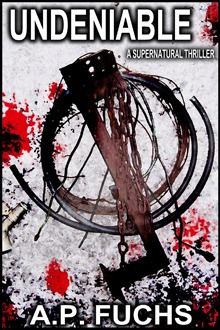
When Duncan and his son Kyle are arrested for their faith, they are subjected to bloody and horrific torture that brings them to sanity’s edge and death’s door.
Physically broken and emotionally spent, the real threat is if they will finally break spiritually.
His eyes removed by his tormentors, Duncan is blind, and it’s only when he asks God to see again is it revealed to him what is really going on beyond the natural realm.
Amidst all the blood, the pain, and the hissing of demons, will Duncan break, or will he prove that Jesus is Undeniable?
Recommended for fans of Frank Peretti and Ted Dekker.
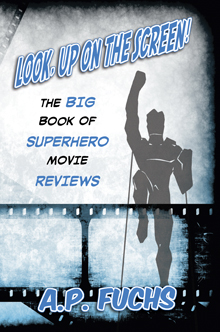
Look, Up on the Screen! The Big Book of Superhero Movie Reviews
Superheroes have invaded film more in the past decade and a half than they have in their entire history. From major blockbusters like Man of Steel and The Dark Knight Trilogy, to DC Entertainment’s line of fantastic direct-to-video animated films, to other super-flicks like The Incredibles, superheroes are enjoying a major resurgence in popular culture and fans have now entered a golden era of superhero cinema.
Lifelong superhero fan and author A.P. Fuchs has made it his mission to see every superhero movie that’s been brought to screen. Collected here are his first one hundred reviews, covering the major blockbusters of today to the lesser-known super flicks of yesterday along with everything in between.
Reviewing such classics as the original Christopher Reeve Superman films to the jaw-dropping Marvel Phase One series that include Iron Man 1 and 2, The Incredible Hulk, Thor, Captain America and The Avengers, to the movies that arguably started the current age of superhero cinema: The X-Men franchise, he’s got this amazing genre covered. Also included are a multitude of animated features, superhero movies that didn’t quite hit at the box office, pulp heroes and more.
Look, Up on the Screen! is a collection of reviews for the serious superhero filmgoer from a diehard fan who’s seen nearly all of what the superhero motion picture field has to offer. Whether your theatre is at the cineplex or in your own home, this is one collection that’s a must-add to your bookshelf of behind-the-scenes goodies, movie guides, superhero film novelizations and graphic novels.
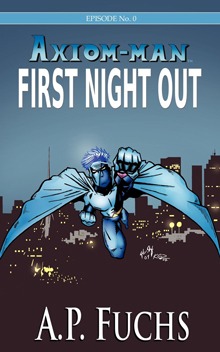
First Night Out (The Axiom-man Saga, Episode No. 0)
The messenger has fled, leaving Gabriel alone with mysterious abilities he knows little about.
The things he can do, the powers–the options are limitless.
But only if he knows how to use them.
As he embarks on the path of discovery, Gabriel must try to understand why he was chosen to receive the most powerful of all gifts and, with the help from no other, come to a decision as to what to do with them.
Even if it takes the death of an innocent to convince him.
Welcome to First Night Out (The Axiom-man Saga, Episode No. 0).
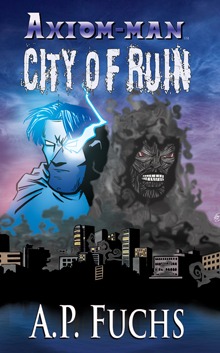
If only relationships were simple. While debating whether to reveal his secret identity to Valerie, Gabriel’s personal plans are put on hold when darkness descends upon the city, each building, street and alley covered in a strange black cloud akin to those from the Doorway of Darkness. Only these clouds didn’t descend from the sky. They came from a mysterious shadowy being known as Bleaken.
With the city under the tyrant’s control, pandemonium ensues and violence erupts on the streets. Screams, gunshots and sirens fill the air; fires are lit, blood is shed and people begin to die.
Axiom-man must navigate the darkness and put an end to Bleaken’s reign of terror before the entire city is destroyed under a veil of black clouds and violence.
Meanwhile, having grown closer as friends, Valerie races into the dark, trying to find Gabriel to make sure he’s safe, only to succumb to a band of madmen on the way that take her down a tunnel of torture and despair that threatens her sanity and soul. If she doesn’t escape, her fate will be sealed and she will meet an end worse than death.
With all hope lost and the city covered in a sea of black clouds, Axiom-man must learn what it takes to truly shine as a light in a dismal place and stand strong against the tides of darkness emanating from all sides.
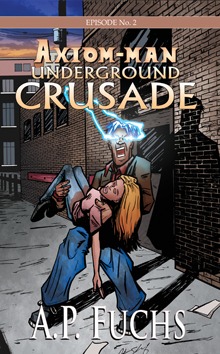
Underground Crusade (The Axiom-man Saga, Episode No. 2)
After exploring the city’s underground in order to get a better feel for the criminal fraternity, Gabriel—under the guise of “Mike”—meets a young woman—Katie—who is more than what she seems. What first starts out as a night of mere surveillance and intelligence-gathering soon forces Gabriel to re-examine his approach to crime fighting, discover his strengths and shortcomings, all while trying to keep up with Katie, who is bent on seeing through her own private crusade.
With danger lurking at every turn and Gabriel being forced to keep his identity—and abilities—as Axiom-man a secret, he soon discovers he isn’t the only one hiding something. There are other players at work in the city, those who would soon misuse a secret weapon for their own purposes.
As the clock ticks down and the violence escalates, Gabriel must try and recover the weapon while also keeping Katie safe.