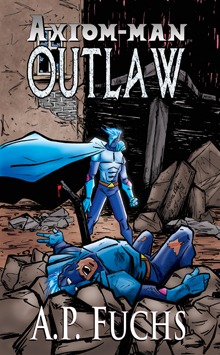
The Axiom-man Saga is my superhero series. It consists of novels, novellas and short stories. There are some comics, but those are peripheral tales. The canon is in the books and stories.
For the completist, this is the order in which to read the series:
Axiom-man
Episode No. 0: First Night Out Doorway of Darkness Black Water (short story)
Episode No. 1: The Dead Land There’s Something Rotten Up North (short story in the anthology, Metahumans vs the Undead) City of Ruin Rite of the Wolf (short story in the anthology, Metahumans vs Werewolves)
Episode No. 2: Underground Crusade Outlaw
For purchasing information, please see the left sidebar.
Note: This post was originally published on Jeffrey Allen Davis’s blog
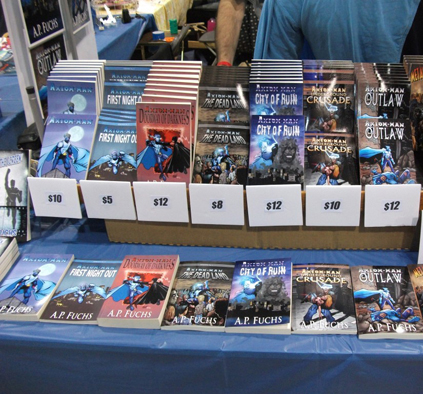
The Axiom-man Saga at the C4 Comic Con 2013
The Axiom-man Origin and Why I Write Superhero Fiction by A.P. Fuchs
The Axiom-man Saga is an old story. A couple decades, in fact, as it was around then that I started to daydream about a similar hero while walking my paper route each morning. I’d get so lost in this story about a hero caught in a cosmic war between Good and Evil that I’d be done my route before I knew it and would often run house-to-house to double check and make sure I delivered the paper to the right places.
In that fantasy, of course, I played the hero. As the story grew and I got older, I ended up transferring the honor of being that character to someone else, a fictitious someone else who would one day go by the name of Gabriel Garrison.
Axiom-man began to take shape in concept throughout all my years of delivering the paper—and went by a different name, which was featured in my novel, April, written as Peter Fox (for that secret name, you’ll just have to read the book to find out). In 1995, Axiom-man received his new costume, the one he wears today. At the time, Axiom-man—originally called Trinity—and this concept character of mine were two different people. Trinity was more of a supernatural hero ala Spawn and fought demons, whereas my other hero was more down-to-Earth in nature and had very Superman-like powers. Yes, I know: Superman isn’t very down-to-Earth, but he does deal with things on this plane of existence 9 times out of 10. Anyway, as time went on, Trinity became Axiom—who was yet another character at the time—and as even more time went on and after being inspired by the likes of Frank Dirscherl and his Wraith character—who back in 2005 had one novel, a comic and a movie in the works—I decided it was time to put my long-thought-about superhero to paper. I merged my paper route fantasy character with Axiom because I always had an affinity for him, and after doing a quick web search on the Axiom name and finding a company out there with the same name, I went and made it my own by adding “man” to the end of it, hyphenated, of course, because that’s who Axiom-man really is: a self-evident truth embodied in a single person, in his case the self-evident truth of being one to do good rather than evil. From there it was an issue of scaling his powers waaaay back and settling upon three of them: strength, flight and eye beams. And when I say I scaled his powers way back, I mean way, way back. When Axiom-man debuted, he could only lift around 1000 pounds, could fly at about 60 kilometers an hour, and his energy beams only carried so much force. I didn’t want to make him too powerful thus making him always the winner and, because of his great strength, have no choice but to always pit him against ultra powerful foes. My story was to take place in our world under the idea of, “If this happened in our reality tomorrow, how would it most likely play out?” Making him with that kind of power set helped keep him grounded in reality and gave me plenty of options for enemies he could fight to sometimes win and sometimes lose against.
His backstory and mythology were left unaltered and kept the same as the character I thought about growing up, still the product of a nameless messenger having visited him and granting him his abilities without explanation. As the story goes on, Axiom-man finds out why he received his powers and how he is caught in a cosmic war that has raged since time immemorial.
The reason Axiom-man made his debut in books rather than comics was because, at the time I brought him to market, I knew of superhero fiction but didn’t think to do it independently. Frank Dirscherl’s The Wraith and Knight Seeker by Eric Cooper showed me otherwise. Axiom-man was originally a comic book character and I even drew a 21- or 22-page comic with him when he was called Trinity back in high school. I still have it somewhere and might publish it one day as a kind of behind-the-scenes thing. Anyway . . .
By doing superheroes in prose, I was able to work alone, could tell the story exactly how I wanted it, and because I was already self-publishing other fiction at the time, had the system in place to get Axiom-man out there.
You know, even though Axiom-man was my first official superhero release, I look over my fiction and every book I’ve written is a superhero novel in some way. Take A Red Dark Night, for example. It’s about a summer camp under siege by blood creatures. One of the protagonists, Tarek, is superheroic in nature, wears an otherworldly outfit complete with a cape, and shoots blue fire from a gauntlet on his forearm.
My epic fantasy book, some quarter million words long, called The Way of the Fog, is about a group of people who get superpowers in a medieval/fantasy-style setting.
My zombie trilogy, Undead World, deals with the supernatural, time travel, and each character is superheroic in how they act, even archetypical in some cases, with comic book-like good vs evil action.
Zombie Fight Night—aside from an aged Axiom-man making an appearance in there, is full of comic book characters monster-wise, everything from werewolves to vampires; to robots to pirates; to ninjas to samurai; and beyond, all battling the undead.
The Metahumans vs anthology series is, obviously, about Metahumans aka superheroes fighting a themed foe throughout each book.
As mentioned, my love story, April, is about a comic book writer who’s fallen in love, and what does he write? Superhero comics.
I think it’s only fitting that superhero fiction in its truest form—an actual superhero storyline—became a part of my repertoire. It seemed inevitable considering my love for the genre. Ever since I knew what a superhero was—at three years old, I think—I’ve been hooked, and not a day in my life has gone by where I haven’t thought about them, theorized about them, fantasized about them, pretended to be them and more. I even wear Superman and Batman onesies to bed for crying out loud!
Calling me a geek is an understatement, but I don’t care. Geeks make the world go round and fanboys are the ones providing people with entertainment. Superhero fiction just happens to be my main venue for doing so.
And where is Axiom-man going from here? Well, thus far, 7 prose books have been released along with a few comics and short stories. The whole saga is planned to be 50 books long, so I’m coming up on being 20 percent finished. The good part is the story is pretty much all mentally written. I had 9 years or so of delivering papers to get the story right, after all.
What I’m enjoying about the superhero fiction format is I’m able to do things with my characters that comic books don’t allow, at least, current superhero comics don’t allow. I’ve long advocated—and still do—that the comic book is the greatest storytelling medium to ever come down the pike, with books being a close second. Why? Because it’s the one-two punch of pictures combined with narration, whereas prose is a text-only medium. I still believe that, but being that at this stage in my career I’m primarily a writer versus a writer/artist, I’m sticking to books and the book medium is capable of telling superhero stories in a way comics haven’t as yet, namely getting inside a character’s head. Very few comic writers have succeeded in that in the past. Superhero comics are far too picture-heavy these days, with flashy computer coloring jobs, flimsy stories and scant dialogue. I miss the old days where there were almost equal amounts of text and pictures. At least with The Axiom-man Saga as it stands now, I can bring the reader dense characters where every thought and feeling is brought to the fore and, hopefully, pull the reader into the characters’ shoes in a way that superhero comics don’t. That’s my main goal with this: bring the reader in so that they feel they are experiencing my fiction versus just reading it. I’ve yet to read a superhero comic where this has happened. I have, however, read superhero books where this has occurred, Batman: Knightfall by Dennis O’Neil being a major favorite of mine and my first foray into the superhero fiction world.
What also sets The Axiom-man Saga apart from any of the current superhero offerings is that it’s a cross-medium superhero story that encompasses books, comics and short stories, all part of the same continuity. This has never been done before, and putting new spins on old things is one of the things I’ve always striven for in my fiction, especially in this industry where things are pretty copycat and cookie-cutter (we all know of certain authors that seem to turn out the same book over and over again just under a different title, right?).
Whether Axiom-man becomes this wild success or remains under the radar, for me it’s about writing the superhero story I always wanted to read, the one I’ve always thought about, and the one that, when my time on Earth is done, is the one I’ll be remembered by. It’s meant to be a career piece, a giant story with a beginning, middle and end, the story of a superhero, his life, and what that means to the world around us.
I invite you to come along for the ride.
Hope you enjoyed this little insight into the Axiom-man origin.
By taking on the role of a publisher, the one who fronts the cost to turn a manuscript into a published book, the self-publisher takes all the risk—but also reaps all the reward as a result. Think of it as an investment. Folks go to the bank all the time and dump in fifty dollars, a hundred dollars, a thousand or more into RRSPs or GICs, money they’ll never touch for years, but while it’s sitting there, it’ll earn them much more than they originally invested given enough time. Self-publishing is the same way. Even if your up-front costs are a thousand dollars, you start selling your books and, depending on format, make $3-10 profit, once you’ve sold 100-333 copies, you’ve made your money back. Everything above that is your return on your investment. And instead of making a dollar or even two dollars a book sold as per the traditional royalty system with the rest going to your publisher—and to be fair, they deserve to make money for bringing the book to market for you and taking care of you during your contract with them—you get to keep all the profits for yourself.
There’s huge potential to make a lot of money self-publishing. Like I said, if you set up your system to ensure you make $3-10 profit per book (i.e. $3 minimum on an eBook sale and $10 or so on the high end for a paperback sale), you could come away with a very secure future assuming the market is kind to you. To sell 50 eBooks would pay my water bill for three months. I could do the same if I sold 15 paperbacks at a convention as I average around $10 profit per sale through those direct-to-reader venues.
Before, a writer would have to sell thousands of copies of their book just to stay afloat because they made anywhere from 80 cents to a couple bucks a book depending on format. Sometimes less. And while it’s great that they sold those thousands of copies so they could pay their bills, imagine how much more they could’ve made had they been able to do the same volume of sales on their own? If they sold 2000 books total and made the aforementioned 80 cents to two dollars, that would be around $1600-4000 in their pocket. If they self-published and averaged $3-10 per sale, that’s a range of $6000-20,000 to their credit. A huge, huge difference, and for some, enough of a difference between having a bed to sleep in and food on the table.
The beauty of self-publishing is the ability to produce a book for a niche market, something that you don’t typically find in the mainstream, if at all. For example, I write superhero fiction. Back when I started doing it in 2006, my series, The Axiom-man Saga, was one of a handful of other independent superhero fiction books. There was no way I could take my manuscript and sell it to a publishing house because no one would take the risk on a completely unknown superhero with no proven track record. Well, guess what? By self-publishing the series, I’ve been able to find an audience for it and every time a new installment in The Axiom-man Saga comes out for a convention or on-line, people buy copies. And when I’m behind on getting a new book out because I’m committed to other projects, people start asking me when the next book in The Axiom-man Saga is coming out.
Self-publishing is also great for those who can’t keep their hands to themselves. Some writers need to be involved with their book every step of the way, and while this goes back to self-publishing enabling the writer complete control of the project, it also lends itself to writers who are also entrepreneurs, who are business people by nature.
There are two types of people in the world: those who take risks and those who don’t. Entrepreneurs are risk-takers. They see the potential for a business and are willing to spend the money—sometimes money they don’t have—to make it happen even though there’s the possibility it might not work out. And that’s their mindset when it comes to self-publishing: it’s a business. And what do businesses do? They manufacture a product and market it to people. Even service-providing businesses do the same because a service is a product. The entrepreneurial self-publisher is someone who isn’t just a creative individual, but also one with a business-oriented mindset, someone who has a vision for their book beyond simply writing it and are willing to take the risk(s) involved to make that vision a reality. While I personally don’t view books as “products” but works of art, from the outside looking in that’s what a publisher does: sells a product.
The other advantage to self-publishing is to take a book and prove to a traditional publisher there is a market for it. There are many stories of writers self-publishing rejected manuscripts—which weren’t necessarily rejected for quality reasons—and turning them into bestsellers. There are also those who have self-published, had major success, and then were picked up by a traditional publisher who took on the publishing duties of the same book. Often, these publishers paid a lot of money to have these books in their catalog because the writer showed them there’s an audience for their book(s) out there. You need to sell several thousand copies to catch a traditional publisher’s interest, something to the tune of 5000 copies-plus, but self-publishing is an excellent way to give a chance at life to a book that otherwise would’ve been sitting in a rejection pile somewhere.
By self-publishing, you are also the sole rights holder to the book. And while true even if you sold the book to a traditional publisher you’d still be the sole author and copyright holder, the traditional publisher would be the one who holds the print and electronic rights to it, meaning they could be the only ones to publish the book in the language they represent. Depending, some traditional publishers take additional rights when taking on a book: audio, film, even foreign translation rights if they are connected in that way. The first two are the most common. By going it alone, you decide who gets what, so if some guy from Hollywood wants to make a movie out of your book, you don’t need to share the monies offered with anyone if you negotiate the deal yourself. You’d also get to decide how much influence you’ll have on the movie, though, of course, if you want too much influence—and how much influence is “too much” is up to Joe Hollywood—then the deal might not happen at all. Regardless, to be the one in charge of deciding what other ways people can experience your story is up to you if you self-publish.
If you’re a salesman or are good with people, then the marketing of self-publishing should excite you. For some, sales are a thrill-of-the-chase thing and for every sale they land, they get a high off it. And to know that for every hour of effort you put into selling your book will reap you and you alone the financial reward of doing so should make you even more excited. Books usually don’t sell themselves, but if marketing and creating campaigns is an area of interest for you, self-publishing is an excellent field to do it in.
As you can see, there are numerous advantages to self-publishing your book, the main ones being control and the potential to make more money. You also get to bypass anyone who might reject publishing your book and just take it directly to the reader themselves and let them decide.
But most importantly, self-publishing is a ton of fun and I love every minute of it. Unless a traditional publisher comes along and can do something for me I can’t do on my own, then I plan on self-publishing for the remainder of my writing career.
I did a panel on Time Management at the Central Canada Lit Fest a few weekends ago. While I went over several points and gave suggestions on budgeting one’s time for writing, my main message was simply this: get it done.
That’s it, and that’s the real secret to a writer’s management of their time. It all comes down to actually writing versus humming and hawing about when to do it or how. Just sit down whenever possible, write, and go until the clock runs out or your story is done.
It really is that simple.
So in keeping with that spirit, I’ve set up word count meters on the side of this blog, the aim being to let you follow along as I write each project. Word counts listed are approximate and are not updated in real time. Likewise, final word counts are estimates. I’ll adjust the meters accordingly if it turns out something will be longer or shorter than predicted. I’ll also try to update my progress whenever possible.
You might also notice the listing of three Secret Projects. They pertain to yesterday’s clue about how I want to present this website. That’s all I’m saying for now and I’ll let you speculate on what they could be. I started one of those Secret Projects today.
In other news, I’m still rereading The Axiom-man Saga so it’ll be a while yet before I start writing the new installments. Need something else to keep my hands busy in the mean time hence the new projects.
So it’s just me, the keyboard, some ideas . . . and getting it done.
As per my last post, the project right now is to reread The Axiom-man Saga thus far. It took a few days to get going, but now I’m in the midst of reading the first book. It’s strange reading it as just a reader versus going over it for edits. I admit that the editor side of my brain is looking at ways to tweak this or change that, but then I remember that I’m reading it for the joy of reading it and also to take notes, no other reason. A writer’s work is never done, it seems. The book was also written by a different guy some eight years ago. I was a different man back then with a different writing style.
It is cool, however, to see the character in his infancy, to see him stumble along as he tries to figure out this whole superhero thing. At the time the story takes place, he’s only been at it four months, a time frame that isn’t long enough for someone to be truly adept at being a hero. It’s also neat considering I know where the story goes and is going, and I’m looking at Axiom-man thinking, Man, you have no idea of the scope of things ahead of you, how your universe and the reason for your existence is this huge thing and here you are still getting used to wearing a costume beneath your clothes.
Like the picture shows, I’ve been taking notes, little things that I want to mention in the upcoming four-book arc or things simply for me to keep in mind while writing it. The main points I’m after are mythology-related and certain items that foreshadow where I’m ultimately leading everybody. I want to make sure I don’t leave anything out because the upcoming storyline is meant to wrap up everything that’s come before.
After reading this first book, it’s onto First Night Out, which takes place between the “Four months earlier . . .” segments of Axiom-man and the novel’s main story.
Like last entry, I’m asking for those who’ve read the series to come forward and write reviews. Reviews help spread the word and I’m hoping to grow The Axiom-man Saga in the coming year into something more prominent in the superhero fiction market.
On a side note, I’m tabling at the Winnipeg Comic and Toy Expo this Sunday at the Viscount Gort Hotel in Winnipeg. Hope those in town can come out, say hi, and talk superheroes with me.
They will make up the first-ever prequel and trilogy in the series. They will still follow the main feature/episode/main feature/episode reading format established thus far, with the prequel to be an episode novella and the trilogy–name to be revealed later–to be one main feature book, an episode, then finishing in a main feature book.
I have these all blocked out in my head and what each one is going to be about. The plan is to tie up all loose storylines from the first seven books.
The cool part, too, is these will all be written marathon-style as I’ve found with my past few books that I write really well just going whole hog and typing 6-10k a day (sometimes more). For this series I plan on writing all four books first then releasing them so fans can get the whole story in one shot instead of waiting between each installment.
The titles for each of the books will be revealed after they are written. I found a word count widget–I think it was yesterday–that I’m going to use for each one and post them on the side of the blog so you can check in and see the progress of each book as I go along. The goal word count will be an estimate as I really don’t know the final word count until a book is finished, but the widget requires I put something as my end game.
This week is Spring Break so my boys are home thus working is tricky as I juggle Dad duty and book stuff, so my first step is to re-read The Axiom-man Saga to date and make sure I remember all loose threads so they can be addressed when I go to town writing the new series. I also have some cool plans for the cover art so I’ll be getting in touch with the artists soon to share with them my vision.
I’m really excited for this next set of books as they’ve been in my head for years but only now is Axiom-man at a point in his superhero career where he is able to take things to the next level.
In the meantime, I’m asking readers who’ve read the first Axiom-man book–or any of the others–if they’d be willing to put up a review on Amazon. Reviews go a long way in selling books and I’d really like Axiom-man to have his day in the sun, so if you’ve enjoyed any of the books in the series, would you be willing to help out and take a few minutes to post a review? The first book in the series can be found on Amazon here. Thank you to those who are able to write something. It means a lot.
I have more things planned as we lead up to the release of this new story arc, but in the meantime . . . I got some reading to do.
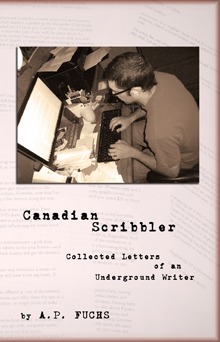
Canadian Scribbler: Collected Letters of an Underground Writer
Bringing together letters from 2005 – 2013, Canadian Scribbler: Collected Letters of an Underground Writer is a look into the world of independent publisher, author, editor and cartoonist, A.P. Fuchs.
Topics include: self-publishing tips and tricks, writing advice, the C4 Lit Fest short story critiques, Fuchs’s superhero epic The Axiom-man Saga, book reviews and commentary, the Second Coming, thoughts on the comic book market, the gray areas of modern day society, and much more.
Includes letters to such literary notables as Stephen King, Dave Sim, George Clayton Johnson, Piers Anthony, Brian Michael Bendis, Kevin J. Anderson and many others.
Always insightful, often witty and consistently inspirational, Canadian Scribbler: Collected Letters of an Underground Writer is a thoughtful collection of letters from one man whose passion for the creative industry—and trying to survive in it—shines through on every page.


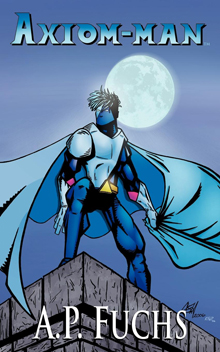 The Axiom-man Saga is my superhero series. It consists of novels, novellas and short stories. There are some comics, but those are peripheral tales. The canon is in the books and stories.


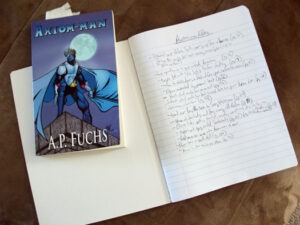 As per my last post, the project right now is to reread The Axiom-man Saga thus far. It took a few days to get going, but now I’m in the midst of reading the first book. It’s strange reading it as just a reader versus going over it for edits. I admit that the editor side of my brain is looking at ways to tweak this or change that, but then I remember that I’m reading it for the joy of reading it and also to take notes, no other reason. A writer’s work is never done, it seems. The book was also written by a different guy some eight years ago. I was a different man back then with a different writing style.