My name is A.P. Fuchs and I’m a writer of words, drawer of pictures, and freelancer in pretty much anything to do with publishing. You are tuned into my blog, Canister X, my official web presence and the Realm of Heroes and Monsters. I’ve been writing and publishing since my first short story sale in 2000, and have been creating and publishing books and comics since 2003.
My Patreon page is here. It’s a special place where I post serial novels, essays on the creative arts business, stuff from behind the scenes here in the Great White North at Axiom-man Central, and more. Join me and my other patrons and be a part of something fun and interesting with regular and reliable content.
Also, on Saturdays, I send out my newsletter, The Canister X Transmission. It’s a weekly newsletter where we all come together after a busy week, unwind, and kick off the weekend. Presently, we are finishing off The Long Year Five, and Year Six will start before the first half of 2020 is over. Join us.
Thank you for coming alongside of me on the blog this month.
Pretty sure I’m stuck in an accelerated timestream.
Anyway, I set out into 2020 with specific goals now that all my prelim work is pretty much done. (All discussed in my newsletter.)
And so . . . here is where some projects stand a couple of weeks into 2020:
Project Rebuild: First batch of second editions are my Undead World Trilogy. The new cover style–which looks incredible–is almost done. Layout to begin soon. Here is the original announcement.
Patreon: New tiers and options to be added once some second editions come out. Gigantigator Death Machine is the current feature playing as a serial novel with a new installment every two weeks. This will run until May, if I counted out the installments correctly. A new serial novel will start up after this first one is done. Please go here to start reading the previous chapters so you’re ready for the next episode.
Artwork: Putting the final touches on a commission. Have permission to share it on-line once the client receives it in the mail.
Freelance: In the middle of a project for someone and still have my client that requires two days a week. (Which slows down my published work output but, hey, need to keep the lights on somehow.)
New published work: This involves all the various projects I mentioned in previous blog posts and in the newsletter. As of this writing, the plan is to do a few second editions first then release something new then more second editions then new work, and so on. This plan keeps me at a pace I can manage, which in turn benefits you by giving you a pattern for 2020 and something to look forward to.
YouTube: The channel is growing and content is going up at, on average, a video a week. Your subscription to the channel helps keep the writing and art machine running so please subscribe if you haven’t already.
Daily blogging: Still on the Monday-to-Friday schedule. I’m doing my best to give you something each day that entertains or informs at least one person. Check back daily for new entries. If you check back and the blog hasn’t been updated, check back again later. Lately, my blogging hour has been shifting for various reasons.
Vacation: Though I took a break over the Holidays, it wasn’t really a break. In the end, I had a few days for a breather because it took me until Boxing Day to finally slow down and just relax. Throw in some Holiday activities during that relax time and I didn’t end up having a genuine break. I was back at it on the 30th. So, things are in motion for a legit winter holiday, but by the time all is arranged, that won’t be until February sometime. Watch this space.
Conventions and public appearances: One convention has been announced. I have irons in the fire in others and am waiting to hear back.
Posted through my social channels this morning:
“Hoping to find new inroads in the publishing world (books and comics) in 2020. I’m convinced the current standard system is terrible. That said, it’s up to creators to create the market, not companies. We need to get that straight first otherwise it’ll be same old, same old.”
I stand by the idea that creators create the market. Read my essay, “Why I Quit the Publishing Industry and Opted to Just Make Books Instead,” to find out my thoughts on the current climate and my general attitude toward it. If you’re a creator reading this, please check out the essay. We’re not at the mercy of various companies to get our work out. They’re at your mercy to provide them work to distribute. They don’t have a business without you. Take that to heart. Stand strong. Make new roads. Find out new ways to share with your readers. You and your readers are the ones in control, not these companies.
Okay. That’s all I’ve got for now. Thank you for checking in.
Publishing Model Visual Documentation by G.M.B. Chomichuk
This morning I once again met with writer/artist G.M.B. Chomichuk and writer/editor Jonathan Ball at Clementine Cafe in Winnipeg’s Exchange District. On top of the outstanding fried chicken on toast I had for breakfast, we got to work talking about the publishing business.
See, I have a major advantage over other writers: I’m tapped into both the book publishing world and the comic book publishing world. While there are similarities in the overall business side of things, there are distinct differences and, I believe, it’s a merge of these two models that are the future of publishing.
What’s happening in the book publishing world at present is an old archaic system at war with the new digital paradigm. While some adaptations have been made, for the most part book publishing is operating on an out-of-date system that doesn’t work in today’s reading climate which is why most writers cannot make a living from their craft. What compounds the problem are publishers–big and small–stuck in the old way of doing things and writers who don’t want to do anything but write. This is a major problem that hurts both publishers, creators, and readers.
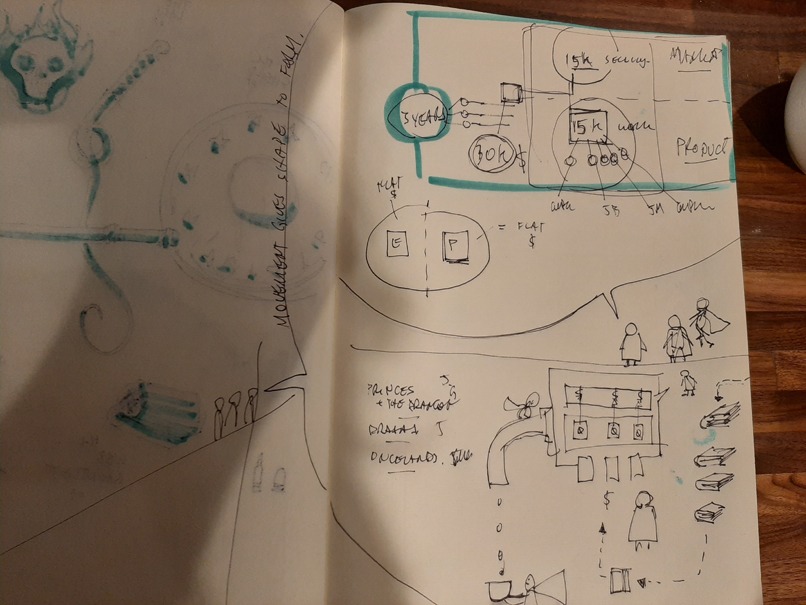
Ground was gained this morning in coming up with a new way of doing things that merges the best of the book publishing world and that of the comics publishing industry while setting aside dated systems that hinder bringing books and comics to the reader. Some of the ideas put forth were new (to me) and others were in line with the bomb that went off when my workload exploded.
The above photo–a visual documentation of our little meeting created by G.M.B. Chomichuk–shows how three creators think when hashing out how to create a publishing system that benefits both the creator and reader. Yes, the image is hard to follow without explanation, but will serve as a future reference point for a venture that was brought up during the meeting (details still to be ironed out).
The main goal with these meetings outside of spending time with friends is to learn something new, have discussion, and then apply those lessons to see what works and what doesn’t.
In the end, it was a productive morning and one that will stew in my brain for a while as I retool things over here.
(Please also see my first entry about my breakfast with these two creators by going here.)
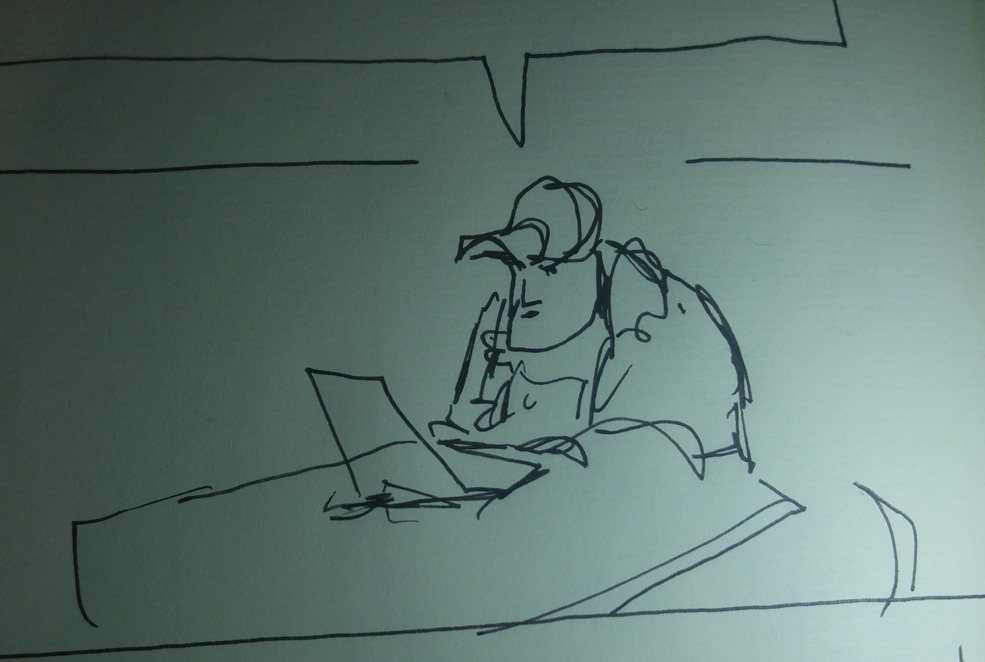
Sketch of A.P. Fuchs at the keyboard by G.M.B. Chomichuk
This morning I had a wonderful breakfast at Clementine Cafe here in Winnipeg with writer/illustrator G.M.B. Chomichuk and writer/editor Jonathan Ball. And while networking wasn’t the reason I chose to see them, it was something that inevitably happened given that all three of us work in the business.
I usually see these dudes at book signings or on the convention circuit, but since I’ve been away from events for a season, it was a pleasure to have a sit-down with them and talk shop and catch up after so long. It was also an opportunity to share work habits and pick each other’s brains over how we do things and what works and what doesn’t, tell stories, and learn a thing or two.
Today I came away with two wins, and in order of occurrence they were: A dynamite breakfast. Had the Turkish eggs and it was brilliant. The second was a writing gig. I’ll reveal more details about that here on the blog when I’m allowed to.
Most creators would rather be holed up in their studio or office and just work. And while that has its charm and is important in order to get things done, it’s also critical time is spent with those in the business. First and foremost, it’s a chance to simply be friends with like-minded people and realize you’re not alone in the universe regarding your creative quirks. Secondly, it might lead to opportunities to use your craft you might not otherwise have had.
In summary, go have breakfast with other creatives when you can. It yields positive friendships and, sometimes, a job.
In June of 2020, I will have been writing for twenty years. Though I was creating before that–primarily comic book art–it was in June of 2000 that I decided to make books my living. I was originally aiming to be a comic book artist but life threw me a curve ball and through various circumstances books became the order of the day.
I’ve been giving thought to a memoir for a very long time. It would be an opportunity to share with readers my creative journey and, when appropriate, my personal journey as well. It would also be a chance to lay my creative life out in front of me where I can see it and visit time periods I haven’t been to since they originally happened. A partial journal effort, so to speak.
Regarding publication, no doubt there would be a formal release of a paperback and eBook, but I’m also thinking of airing it on-line first, whether here at Canister X or on my Patreon or both.
It’s been a wild ride to get to the present day. I started out crafting stories completely naive as to how this business worked and hit many roadblocks along the way. The plan for this project will require further thought but I think I’ve already settled upon the process so I can create it without it overloading my already-hectic schedule.
It’s important for every creator to make a schedule for their creative time. The idea of “creating when inspired” or “in the mood” doesn’t work. (Been there, done that.) Not very long ago I was mocked on-line for suggesting a creative schedule to someone who was having trouble creating. The answer I proposed to their problem was to treat it like a job and just do it. Most seasoned creators will tell you that you have to create whether you feel like it or not if you want a career in this business.
The formula is simple: Approach this casually, you’ll get casual results. Approach this diligently, you’ll get diligent results.
There is no way around this. And, usually, once you get going on a project after deciding to start working, the project starts to flow on its own anyway.
Schedule out your time. Schedule out your projects.
It’s worth taking the time to do this step. In fact, it actually saves you time later in a multitude of ways.
October has just started and I had to spend some time thinking about what this month will look like in terms of work (roughly). If I’ve learned anything from my years in this business, it’s that one needs to be organized. Fortunately, my natural thinking process involves putting everything into lists under various headings and then looking at those items and breaking them down day by day. Some stuff is written down on paper, other stuff is written down in my head. Regardless, those items are then transferred to a calendar—both real and mental—thus informing me what each day entails. For the most part, I’ve learned to leave tomorrow in tomorrow, even parts of today in their respective parts of today. All that matters come nightfall is that the day’s tasks are done.
This eliminates confusion and keeps a rein on anxiety.
So what does my October to-do list look like?
So far:
– regular Web upkeep like this blog and backlog SEO work
– edits for a client
– finding out the finer details for a job I’m signing papers for tomorrow and then doing the work thereof
– Inktober until the end of the month (daily ink drawings posted to my social media channels)
– Ship off Kickstarter rewards for the Axiom-man/Auroraman: Frozen Storm campaign to Jeff Burton (this includes getting things done at the local printer for the paperback; my part of the lettered edition hardcover is done)
– posting the Gigantigator Death Machine serial novel, behind-the-scenes stuff, and essays to Patreon
Note: This entry is from that file I found and is a reflection of how I felt at the time I was originally going to post it. I’m entering it here in the interest of archival purposes.
I’ve spent a great deal of my career offering as much advice and knowledge I could about how this business works. I’ve given everything from writing tips to marketing ones to going against the grain in some circles only later to be proven right. Upon reflection, I’ve pretty much said everything I have to say about this business. All of it is chronicled on this website, my newsletter archives (and collected editions), Canadian Scribbler, and social media posts.
I think it’s time to step back and let others discuss those topics and just focus on my own work. See, I love this business so much it upsets me when I see something poorly handled or writers being misled and I’m compelled to say something. I think that season is coming to a close now. Will it be permanent? I don’t know. But will it be for right now? Yeah.
The Canister X Transmission newsletter archives contain info upon info and can be accessed here.
Thanks for listening to me all this time, but it’s time for me to move on. Stories to tell. Pictures to draw. Books to make.
Just trying to help, is all. Lots of creators ask me questions because I’ve been in this business for so long. These little posts I’m broadcasting are meant to answer some and also provide encouragement to those who feel like throwing in the towel. Are they annoying? Maybe. Are they helpful? Maybe, too. Hope they are, anyway.
Time to keep working. If you have questions about any aspect of publishing, send me an email and I’ll do my best to answer in a timely manner.
It’s easy to get competitive in this business and try and match the success of your fellow creators. While healthy competition is good, when that competition grows dark and is borne out of jealousy, resentment sets in. It’ll suck the life out of you and your mental and emotional energy will flow to those dark places instead of to good places like creating more work and promoting it accordingly.
Your fellow creators aren’t your competition. At most, it can be a little bit of friendly sibling rivalry, but anything south of that and you’re looking for a world of heartbreak and anger.
Put your energy into your work instead of into competition. It’s that simple.